



Table of contents
Share Post
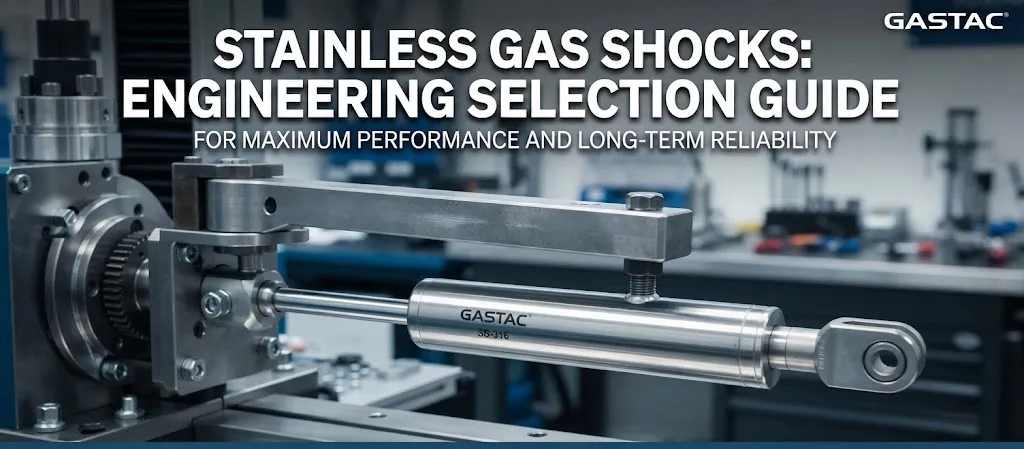
Are the Internals of Stainless Gas Springs Fully Stainless?

When sourcing hardware for marine environments or high-hygiene food processing equipment, buyers quickly learn that not all stainless gas springs are created equal.

You find a supplier, the specification sheet says “316 Stainless Steel,” and the outer cylinder looks flawless. But a critical question remains: Are the internals of these stainless gas springs fully stainless, or is it just the outer tube?

Let’s look inside the cylinder to see what separates a true marine-grade component from a cheap alternative.

The Industry Secrecy: Fully Stainless vs. Hybrid Construction

In the industrial manufacturing market, there are two primary ways manufacturers build a “stainless steel” gas spring:

  • Hybrid Construction (The Cheap Way): To cut costs, many suppliers only use stainless steel for the external cylinder and the visible piston rod. The hidden internal components—such as the internal piston, valving system, guide bushings, and retaining rings—are made of standard carbon steel or zinc-plated metals.
  • True Full Stainless Construction (The GASTAC Way): Every single component, from the large outer housing to the smallest internal shim, valving disc, and piston core, is machined from solid high-grade 304 or 316L stainless steel.

Why Carbon Steel Internals Fail (The Metallurgy Breakdown)

If the internal carbon steel parts are completely sealed inside and surrounded by non-reactive nitrogen gas, why does it matter? It matters because of two major engineering factors:

  • Moisture Trapped During Manufacturing: Regular atmospheric air contains ambient moisture. If a factory does not use a 100% pure vacuum-charging process, micro-droplets of water get sealed inside. This moisture attacks internal carbon steel parts immediately, creating internal rust.
  • Corrosive Hydraulic Oil Breakdown: Over millions of cycles, the internal hydraulic oil degrades and can form trace acidic compounds. While stainless steel internals ignore this chemical shift, carbon steel parts will experience micro-pitting.

Once internal rust or pitting occurs, the rough surfaces quickly tear the internal rubber seals from the inside out. The result? Your gas spring suddenly loses pressure and soft-fails.

Component Checklist: What Must Be Stainless?

To ensure maximum structural integrity and prevent unexpected lifting failure on a boat hatch or medical enclosure, ensure your manufacturer utilizes stainless steel for these three critical internal zones:

  • The Piston Core & Valving: This assembly directs the gas flow. If it rusts, the stroke velocity becomes unpredictable.
  • Internal Retaining Rings & Shims: These small rings lock the seal pack in place under 150 bars of pressure. Carbon steel rings can corrode and snap, causing catastrophic pressure loss.
  • The Extension Guide Bushing: This guides the rod smoothly. Stainless construction ensures zero metal-on-metal friction contamination over time.

Engineering Summary for Sourcing Teams

Buying a gas spring with carbon steel internals for a saltwater application is a ticking time bomb. The outside will look brand new, but the inside will slowly destroy itself.

At GASTAC, we believe in complete engineering transparency. We specify the exact metallurgy of both our external housings and our internal valving mechanics so your engineering team knows exactly what to expect under heavy workloads.

To map out the exact material specifications, mounting angles, and environment tolerances required for your next production run, review our complete technical checklist: Factors to Consider When Selecting Stainless Steel Gas Shocks.

张航

Stay in the loop

Subscribe to our free newsletter.

Leave A Comment