In the world of industrial motion control, material selection is the boundary between operational success and catastrophic failure. For environments defined by high humidity, salt spray, or stringent hygiene requirements, standard carbon steel components often fall short. This is where Stainless Steel Gas Shocks become an engineering necessity.
Below is a comprehensive technical guide designed for engineers and procurement specialists looking to optimize their systems with high-performance stainless steel solutions.
What are Stainless Steel Gas Shocks?
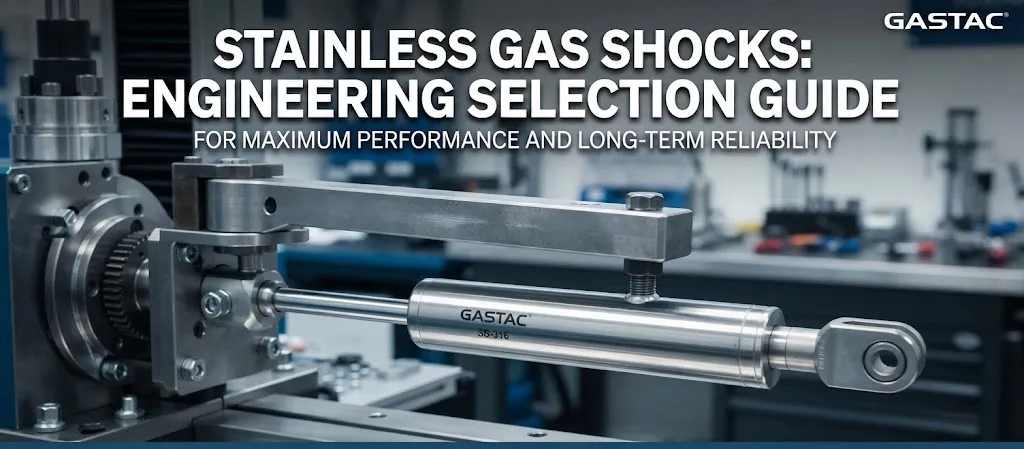
Stainless steel gas shocks are motion control devices that use compressed gas and a piston mechanism to provide controlled lifting, support, damping, and positioning force. They are manufactured with stainless steel components to offer superior corrosion resistance and durability in harsh or moisture-exposed environments.
“As a gas spring manufacturer, we receive frequent technical inquiries about stainless steel gas shocks. This FAQ summarizes key answers from our engineering experience.”
It is called a gas spring because it stores energy using compressed gas inside a sealed cylinder instead of a mechanical coil. When compressed, the internal gas pressure rises, creating a smooth counter-force that pushes the rod back out.
The cylinder is charged with pure Nitrogen gas (N2). Nitrogen is an inert, non-flammable gas that remains stable and does not react with internal seals or oil under high pressure or temperature changes.
This chemical stability under pressure is widely utilized in precision gas spring engineering (see the technical community breakdown on Gas Cylinder Compressed Gas Dynamics ).
In premium lines, both the outer tube and all internal mechanisms are made of stainless steel. If a manufacturer uses carbon steel internally, moisture will cause hidden rust, destroying the seals and causing rapid pressure loss.
Want to delve deeper into the physics of gas springs ? Join the discussion on Reddit to exchange insights and connect with like-minded professionals.
Constant Force: A mechanical spring gets exponentially harder to push as it compresses, while a gas spring delivers a nearly flat, constant force throughout its stroke.
Controlled Motion: Mechanical springs snap back violently; gas springs use internal oil dynamics to provide smooth, cushioned deceleration.
We recently unpacked the structural fatigue and velocity control differences of gas springs vs. coil springs with mechanical engineers over on Quora. Check out the community thread and join the deep dive here:Join the Discussion on Quora.
-
Gas Springs (Push Force): Filled with high-pressure gas to actively push out and lift or counterbalance heavy loads.
-
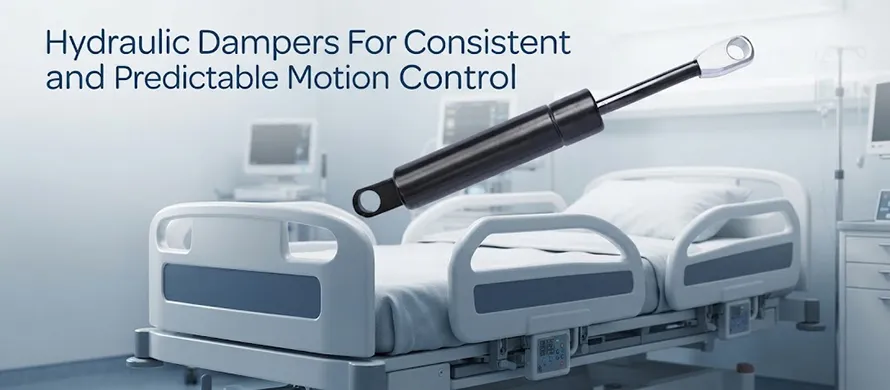
Hydraulic Dampers (Resistance Only): Contain no high-pressure pushing gas; they are filled with oil strictly to absorb energy and slow down motion.
For a deeper dive into the mechanical differences, check out this discussion on What is the difference between gas struts and hydraulic dampers?
How Stainless Steel Gas Shocks Work?
Stainless steel gas shocks work by using compressed nitrogen gas inside a sealed cylinder to create force. When the rod is pushed inward, the gas becomes compressed and stores energy. As the pressure increases, the gas pushes the piston rod outward in a controlled motion.
A piston attached to the rod moves through the cylinder while hydraulic oil helps control the movement speed and damping effect, allowing smooth extension and compression during operation.
“As a professional gas spring manufacturer, we are often asked about stainless steel gas shocks. Here we share practical answers based on real industry applications.”
High-pressure nitrogen presses on both sides of the internal piston. Because the piston rod occupies space, one side has less surface area than the other. This area imbalance creates a constant outward push. This exact mechanical principle is a frequent topic among design engineers, as seen in this detailed Reddit breakdown on
How marine gas springs generate lifting force
, which illustrates exactly how this area differential prevents pressure failure under load.
The internal oil does two things: it lubricates the main rubber seals to prevent gas leaks, and it creates hydraulic resistance at the end of the stroke to provide a smooth, cushioned stop.
Yes. Gas pressure changes with temperature. Hotter temperatures expand the nitrogen and increase the lifting force, while extreme cold drops the internal pressure, making the gas shock feel softer.
Premium shocks use multi-lip dynamic seals that maintain a tight radial grip on the moving rod. A microscopic film of internal oil stays trapped between these lips, blocking high-pressure gas molecules from escaping.
As the solid steel rod enters the cylinder, it occupies space and reduces the internal volume. This compresses the nitrogen gas into a smaller area, naturally driving the pressure and force up.
What Materials are Used for Stainless Steel Gas Springs?
When selecting stainless steel gas shocks, the most common material choice is between 304 and 316 stainless steel. Both are widely used in industrial motion control applications, but they perform differently depending on the working environment.
304 Stainless Steel Gas Springs
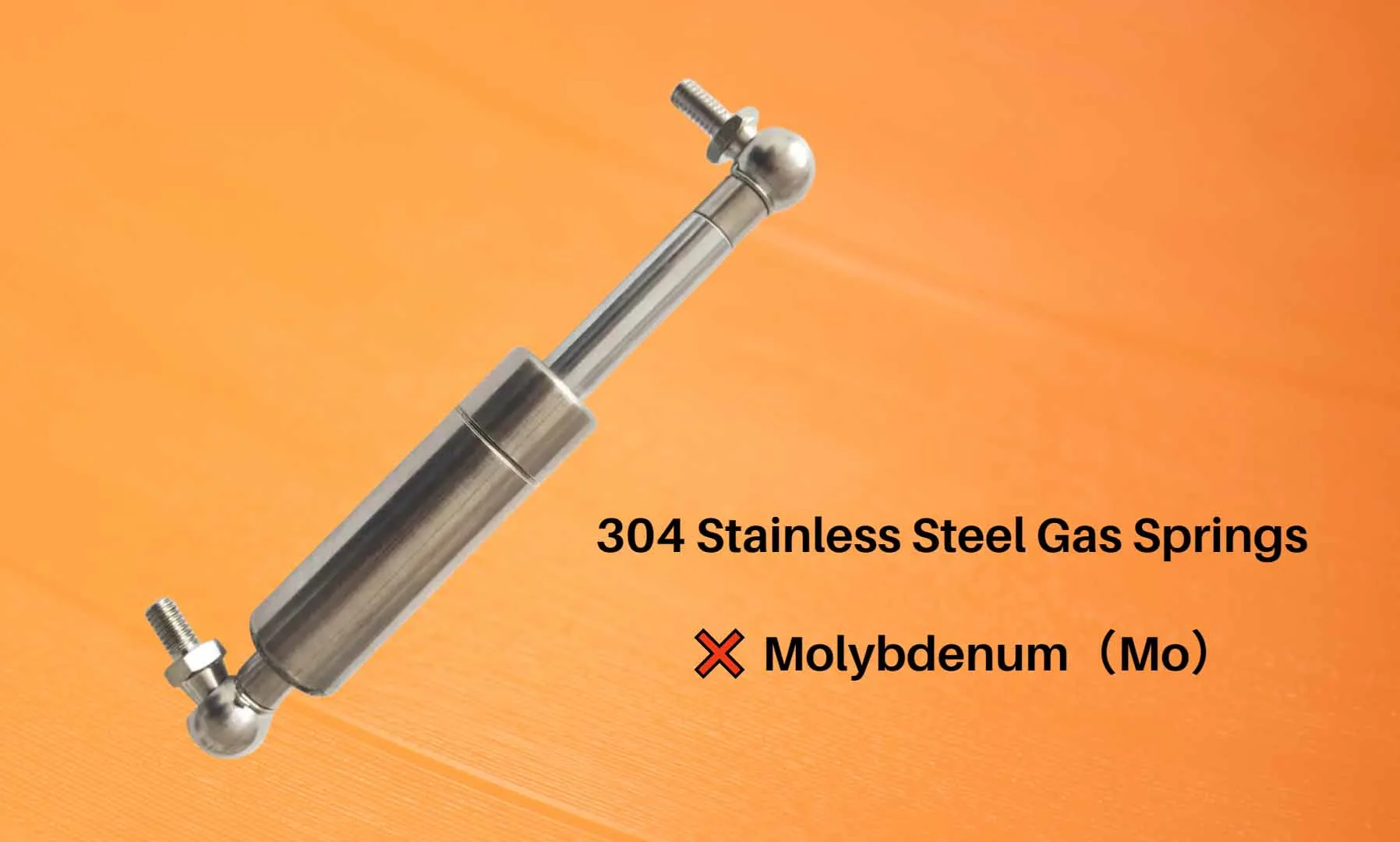
Named under the SAE system, 304 is an austenitic alloy defined by its 18% chromium and 8% nickel composition. It provides exceptional mechanical tensile strength and baseline oxidation resistance, securing internal cylinder stability in standard industrial environments.
316 Stainless Steel Gas Springs
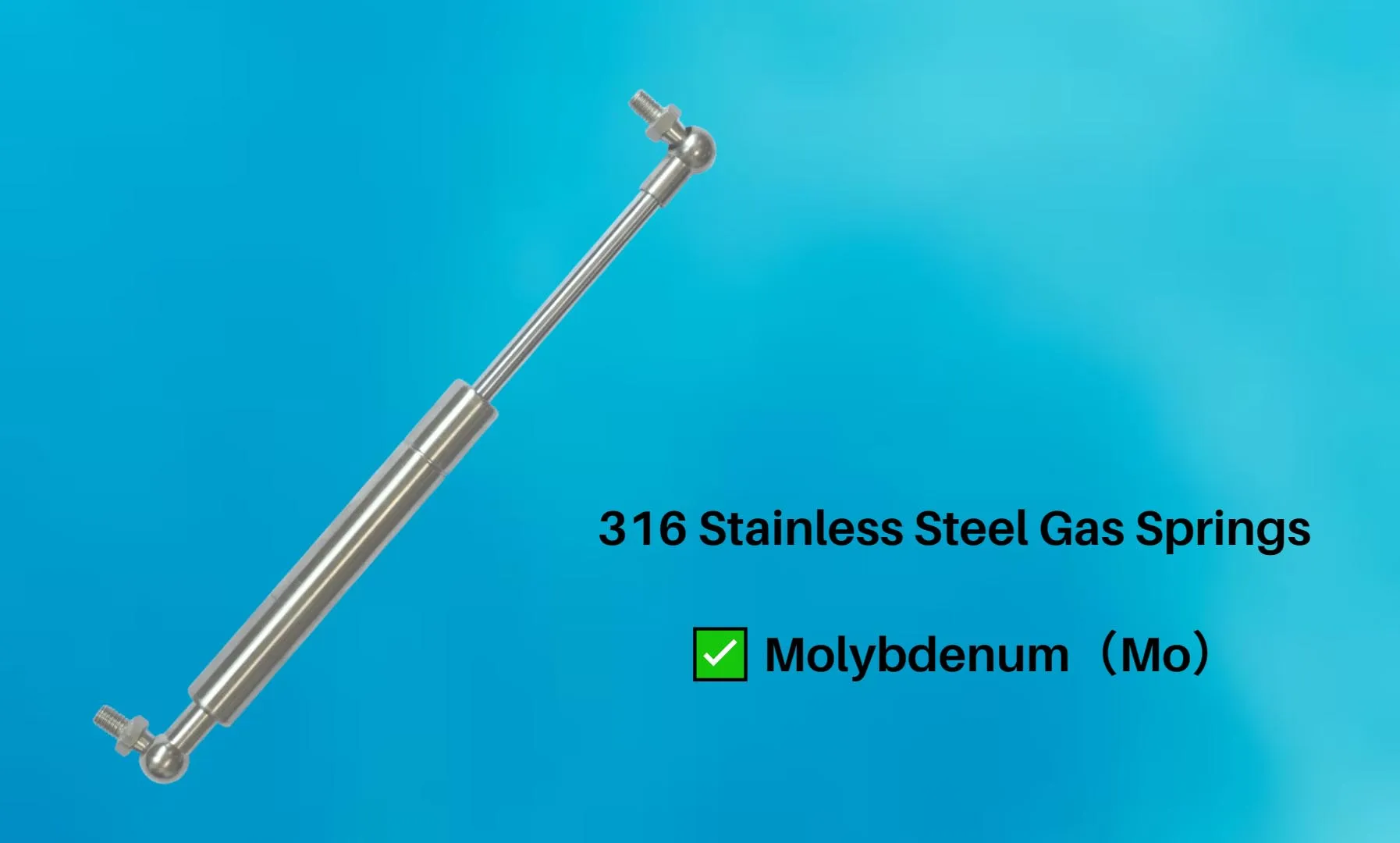
Also an SAE designation, 316 builds upon the 304 baseline by adding 2%–3% molybdenum to its alloy matrix. This chemical modification specifically prevents chloride pitting and catastrophic crevice corrosion under severe marine and salt-spray exposure.
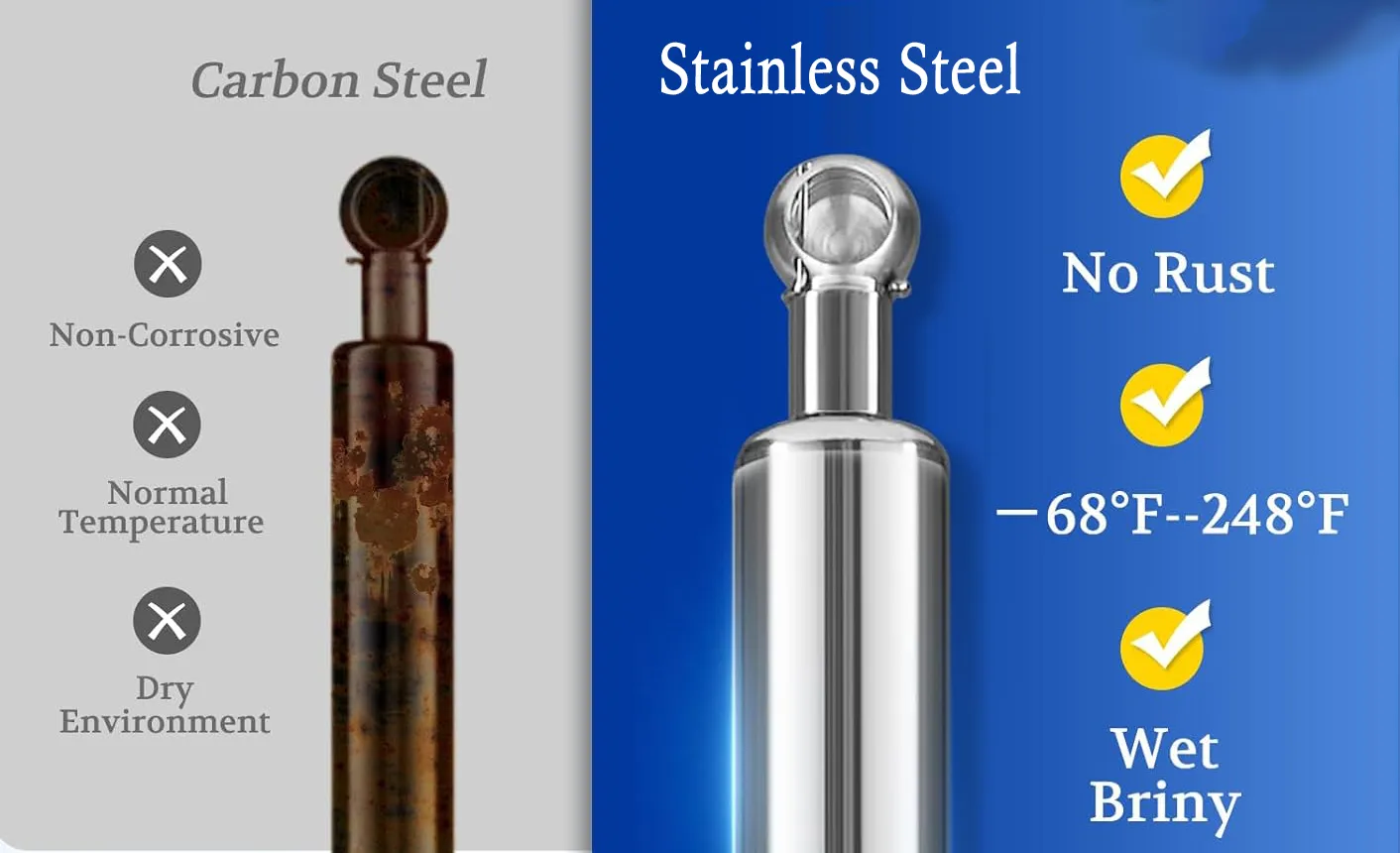
Selecting the right material is critical for component performance in corrosive environments. As a leading gas strut manufacturer, we’ve gathered the most frequent inquiries from our partners to provide authoritative answers on stainless steel material properties and durability standards."
Grade 304 lacks molybdenum, making it vulnerable to chloride pitting from salt spray. This breaks down the protective oxide layer, causing surface rust. Marine environments require an upgrade to Grade 316.
To review the specific physical mechanics behind this surface breakdown, see the technical explanation regarding why stainless steel gas springs develop brown rust stains in marine environments on Quora
.
You cannot tell them apart visually because they look identical and are both non-magnetic. Verification requires Material Test Reports (MTR) or X-ray fluorescence (XRF) chemical testing to prevent material mixing.
You can visit this Quora discussion to explore more inspection methods, or leave a comment below to share your own testing protocols.
No. For sheltered, indoor environments free of chemical or saltwater exposure, Grade 304 offers excellent protection. Opting for 316 adds unnecessary material costs without providing any operational benefits.
To calculate the exact ROI for your specific application, reference How do you determine if 316 stainless steel is worth it?
No. The addition of molybdenum improves chemical corrosion resistance, not mechanical strength. Both materials handle identical mechanical loads and internal pressure limits under the same dimensions. For engineers running stress calculations or sizing hardware, this answers the exact technical doubt raised in the thread: Do 316 stainless gas shocks offer a better load capacity than 304? Material grade dictates corrosion fatigue limits, but dimensional engineering dictates the actual force.
Cold working during the manufacturing process—such as drawing the outer tube or stamping the end fittings—can alter the micro-structure of austenitic 316 steel, inducing slight magnetism. This is a normal physical reaction and does not mean the material is low-grade or counterfeit. In fact, this precise metallurgical phenomenon explains why 316 stainless steel gas shocks show magnetism, a common point of confusion that frequently arises during incoming quality control (IQC) inspections.
No material is entirely immune. While 316 resists salt spray excellently, stagnant saltwater or trapped marine mud creates an oxygen-deprived environment that can still cause crevice corrosion over extended periods. This specific risk highlights why naval architects and offshore engineers frequently debate whether 316 stainless steel gas springs can rust in stagnant seawater. To mitigate this electro-chemical threat, regular freshwater rinsing is still highly recommended to maximize service life.
What are the Applications of Stainless Steel Gas Springs?
The superior metallurgical properties of stainless steel—specifically its resistance to oxidation and chemical degradation—make these gas springs essential in sectors where standard carbon steel would fail within months. At GASTAC, our components are engineered to meet the rigorous demands of the following high-stakes industries:
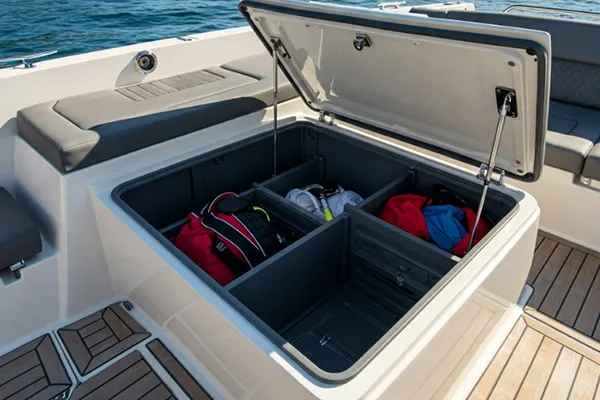
Marine and Offshore Engineering
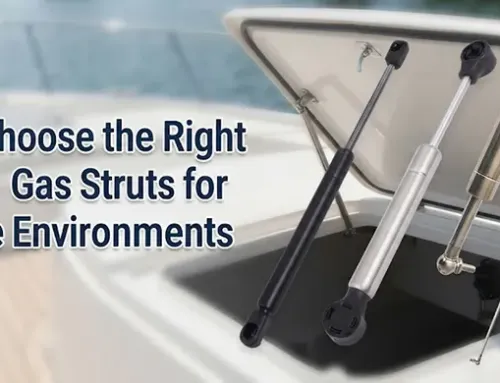
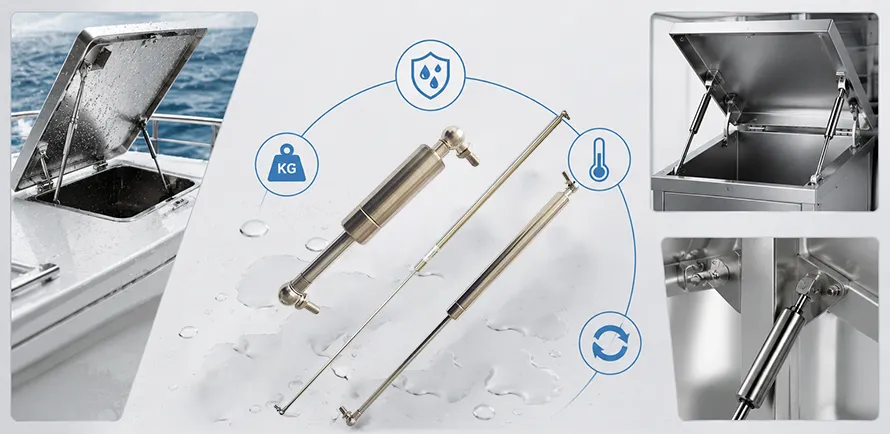
In marine environments, components are exposed to constant salt spray, high humidity, and UV radiation. Stainless steel gas springs, typically made from Grade 316L, are widely used for engine hatches, deck boxes, and boarding gates due to their high corrosion resistance.

Medical and Healthcare Equipment
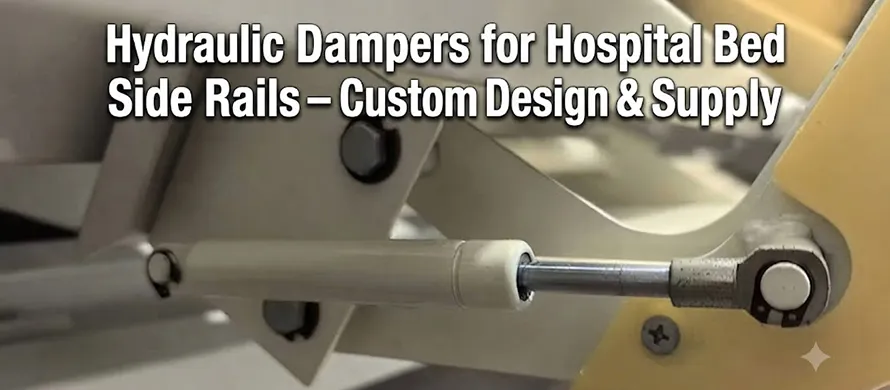
In sterile environments, stainless steel is selected for its non-magnetic properties and its ability to remain unaffected by aggressive disinfectants, making it ideal for surgical tables, hospital beds, and diagnostic imaging equipment.
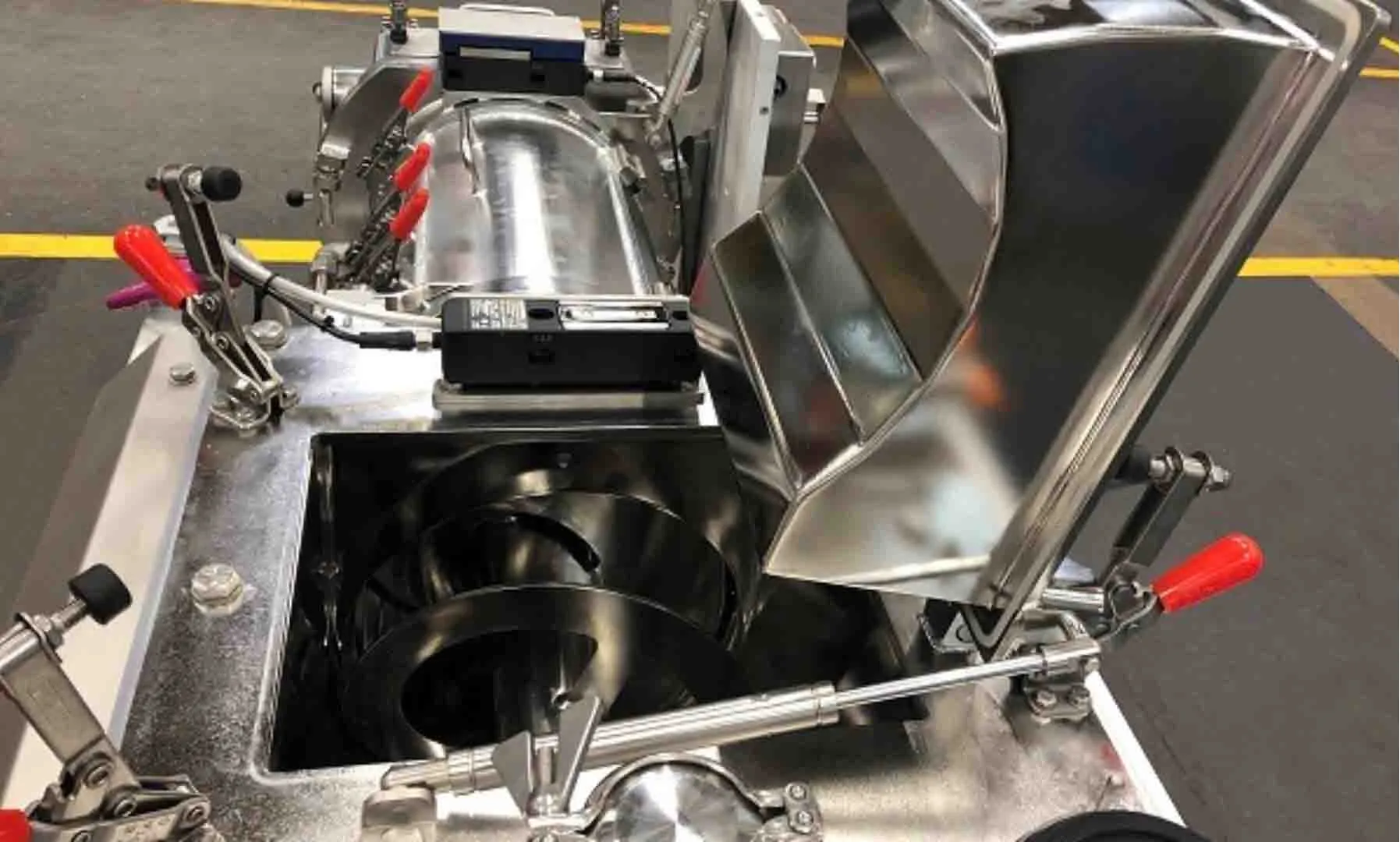
Food and Beverage Processing
These components are essential for machinery requiring frequent high-pressure wash-downs—ensuring full compliance with hygiene standards across safety guards, bottling lines, conveyor adjustment mechanisms, milk storage tanks, and insulated food transport containers.
“As a professional gas spring manufacturer, we are often asked about stainless steel gas shocks. Here we share practical answers based on real industry applications.”
Because of chemical contamination. While 316 stainless steel handles cleanings perfectly, food and medical lines strictly require NSF H1 food-grade internal oil. Standard marine shocks use industrial oil, which will ruin the batch if a leak occurs.
Because of wind-induced side-loads. Gas springs only handle straight, linear movement. When coastal winds slam or twist an outdoor gate sideways, it bends the stainless steel rod and permanently destroys the internal seals.
Standard models are not. Regular rubber seals (NBR) quickly degrade, harden, and leak nitrogen when exposed to temperatures above 80°C. For high-heat industrial applications, the gas spring must be customized with specialized high-temperature internal seals (such as Viton/FKM) to maintain structural integrity.
No, because gas shock force fluctuates based on ambient temperatures. In extreme Arctic cold, the internal nitrogen contracts, dropping the output force and potentially causing heavy hatches to slam shut. You must calculate the temperature-dependent force variations (F1 force changes) before deploying them across fluctuating climates.
What are the Specifications for Stainless Gas Struts?
GASTAC provides a comprehensive range of stainless gas struts designed to meet the rigorous demands of global industrial applications. To ensure the perfect balance between cost-efficiency and technical precision, we offer both readily available standard specifications and fully tailored custom options based on your specific mechanical requirements.
Stainless Gas Springs Standard Specifications
Standard specifications are engineered for universal compatibility and rapid delivery. These units follow industry-standard dimensions for rod and cylinder diameters, stroke lengths, and force ratings, making them the ideal choice for general-purpose machinery, standard maintenance, or quick-turnaround projects.
| Gas Spring Size | Stroke (Rod) Length Min / Max (in 5mm increments) |
Tube Length Min / Max (in 1mm increments) |
Force Min / Max (in 5N increments) |
Thread Type |
|---|---|---|---|---|
| 6/15 | 30-300 | 55-590 | 50-500 | M5 x 0.8 |
| 8/18 | 30-500 | 60-1300 | 100-700 | M6 x 1.0 |
| 10/22 | 50-800 | 85-1300 | 100-1100 | M8 x 1.25 |
| 14/28 | 100-1000 | 100-1300 | 500-2000 | M10 x 1.5 |
Stainless Gas Springs Custom Specifications
Custom specifications are developed for specialized OEM projects where precise motion control and environmental resilience are critical. By utilizing advanced kinematic analysis, GASTAC can tailor exact force tolerances, unique stroke geometries, and specific damping profiles to integrate seamlessly with your unique mounting configurations.
| Size | Stroke Range | Force Range | K-Factor | Extended Length | Materials |
|---|---|---|---|---|---|
| 6/15 | 30 – 300 mm | 50-500 N | 1.55 | 2 × Stroke + 85 mm | Stainless Steel |
| 8/18 | 30 – 500 mm | 100–700 N | 1.60 | 2 × Stroke + 85 mm | Stainless Steel |
| 10/22 | 50 – 800 mm | 100–1300 N | 1.60 | 2 × Stroke + 100 mm | Stainless Steel |
| 14/28 | 100 – 1000 mm | 500–2000 N | 1.70 | 2 × Stroke + 100 mm | Stainless Steel |
“As a professional manufacturer, GASTAC often assists clients who are unfamiliar with gas spring sizing. Based on real-world applications, we have summarized the most common dimensional challenges to help you find the perfect fit..”
Because two struts with identical extended lengths can have different stroke and cylinder ratios. If the stroke is too short, your hatch won't open fully; if the cylinder is too long, the strut will jam before the hatch closes.
The opening speed is determined by the internal hydraulic damping and oil viscosity specification, not the gas pressure. If your application needs a slow, controlled lift to protect hinges, you must specify a high-damping model.
No. Gas struts share identical physical dimensions (e.g., 8mm rod / 18mm cylinder) but can be charged to entirely different force specifications, anywhere from 50N to 800N, depending on the internal nitrogen pressure.
The thread specification (such as M6x1.0 or M8x1.25) dictates what mounting hardware can connect to the strut. If your application handles high-vibration loads, you must specify a deeper or larger thread size to prevent the end fittings from shearing off under tension.
Yes. The diameter ratio (like 8mm/18mm vs. 10mm/22mm) directly dictates the progression rate of the force. A larger rod displaces more internal volume when compressed, meaning the force specification will spike much higher at full compression compared to a thinner rod.
What is the Lifespan of Stainless Gas Springs?
The service life of a stainless steel gas spring is generally defined by two factors: the number of mechanical cycles it can perform and its ability to resist environmental degradation over time.
1. Mechanical Cycle Life
In controlled industrial environments, high-quality stainless steel gas struts are typically engineered to last between 50,000 and 100,000 cycles.
-
A "cycle" is defined as one full extension and one full compression of the rod.
-
The actual cycle life depends on factors such as the internal pressure (force), the frequency of use, and the specific damping characteristics of the unit.
2. Environmental Longevity
The primary advantage of stainless steel—particularly Grade 316L—is its ability to maintain its lifespan in conditions where standard carbon steel would fail prematurely.
-
Corrosion Resistance: Standard gas springs often fail because rust on the rod damages the internal seals, leading to gas leakage. Stainless steel prevents this surface pitting, ensuring the seal remains airtight even in salt-heavy marine environments or chemical processing plants.
-
Chemical Stability: In medical or food processing settings, these gas springs withstand frequent high-pressure wash-downs and aggressive disinfectants that would otherwise degrade the hardware's structural integrity.
“As a professional manufacturer, GASTAC often addresses client questions regarding the lifespan of stainless gas springs. If you are unfamiliar with how long these components should last, we have summarized practical insights into their service life and durability based on real-world applications.”
Under normal operating conditions, a high-quality stainless steel gas spring typically lasts between 30,000 to 50,000 cycles, or roughly 3 to 5 years. However, exposure to continuous saltwater, heavy debris, or high-frequency operation will drastically shorten this baseline lifespan.
This premature failure is almost always caused by seal degradation due to incorrect mounting. If installed rod-up, the internal seals dry out and leak nitrogen gas. Additionally, tiny scratches or salt crust buildup on the polished rod will tear the seals during compression, ending its lifespan early.
Not in terms of mechanical cycles. In a clean, sheltered environment, both materials deliver the exact same fatigue life. However, in highly corrosive marine environments, a 304 spring will fail prematurely due to rust pitting on the rod, making the 316 model much longer-lasting in real-world coastal conditions.
Internal nitrogen gas expands in heat and contracts in cold, directly altering the internal pressure. Continuous, extreme temperature fluctuations cause the internal rubber seals to harden and lose elasticity (thermal fatigue), which accelerates nitrogen micro-leaks and shortens the overall service life of the strut.
The most common warning sign is a gradual loss of extension force, meaning the hatch or door feels noticeably heavier to lift. If you see visible hydraulic oil leaking around the piston rod seal, the gas spring has reached total failure and must be replaced immediately.
What are the Causes of Failure for Stainless Steel Gas Shocks?
Stainless gas shocks can encounter various issues during operation, and many users are often unsure whether a decline in performance constitutes a complete failure. To help you make an accurate judgment, the following are the most common failure symptoms observed in real-world applications.
- 1
Insufficient Support Force: The most common sign of failure is when the shock can no longer hold the weight of the application, which usually means the internal gas has leaked through the seals.
- 2
Excessive Oil Leakage: While a thin film of oil is necessary for lubrication, any visible dripping or heavy buildup around the seal indicates a mechanical breach.
- 3
Rod Surface Damage: If you notice scratches or pitting on the piston rod, these imperfections will eventually tear the internal seals and lead to a complete loss of pressure.
- 4
Loss of Damping Control: If the motion becomes jerky, inconsistent, or lacks a smooth "soft close" effect, the internal hydraulic system is no longer functioning as intended.
"As a professional manufacturer, GASTAC often assists clients who are unsure how to determine if a gas spring has failed. If you are not certain which signs to look for, we have summarized the most common failure symptoms for your reference."
Clients frequently face this. It is almost always due to nitrogen gas leakage. This happens because the internal rubber seals dry out (often from being mounted upside down) or get torn by a scratched rod.
Clients ask this to save costs, but the answer is no. Gas springs are sealed, high-pressure units. Once a seal fails and gas escapes, the unit cannot be recharged or repaired and must be replaced.
Clients are often surprised when steel bends. This happens because the spring was hit by side-load forces (like ocean wind hitting a hatch sideways). Gas springs only handle straight, linear movement, not lateral loads.
This is a major complaint from marine clients. Grade 304 lacks molybdenum, so salt spray rapidly breaks it down, causing surface rust that destroys the internal seals during compression.
Clients notice this during winter. Extreme cold contracts the internal nitrogen gas, dropping the lifting force. It can also thicken the internal hydraulic oil, increasing resistance and making the spring feel locked up.
What are the Common Failure Modes for Stainless Gas Shocks?
Stainless steel gas shocks are prized for their corrosion resistance, particularly in marine or medical environments. However, they are not invincible. Failure typically occurs when the internal pressure is lost or the mechanical seals are compromised. Here are the primary causes of failure for stainless steel gas shocks:
- 1
Gas Permeation & Seal Degradation: The most frequent cause; nitrogen gas escapes as the internal seals (Nitrile or Viton) lose elasticity or wear down over time.
- 2
Surface Pitting & Abrasion: Even 316L stainless steel can develop micro-pitting in salt-heavy environments; these microscopic craters act as abrasives that tear the seals during each stroke.
- 3
Side Loading (Mechanical Misalignment): Non-linear force caused by improper mounting, which creates uneven pressure on the seal and allows gas to bypass the rod.
- 4
Chloride-Induced Crevice Corrosion: Specific to stainless steel, where chloride ions attack the "passive layer" in stagnant areas (like the seal interface), leading to structural compromise.
- 5
Loss of Hydraulic Damping: Failure or leakage of the internal oil chamber, which removes the "soft close" effect and leads to violent, uncontrolled extension.
- 6
Thermal Fatigue: Exposure to extreme temperature fluctuations that causes the seals to shrink or harden, resulting in immediate pressure loss (often called "cold leaking").
"As a professional manufacturer, GASTAC frequently encounters clients with misconceptions regarding the causes of stainless steel gas shock failure. To clarify, we have compiled the following warning signs to help you accurately identify potential malfunctions."
The most obvious indicator is visible hydraulic oil leaking around the rod entry point. Because the internal oil is designed to lubricate the seals, any oil pooling outside means the seal integrity is gone, and the nitrogen gas has already escaped.
This is a seasonal failure situation known as temperature-dependent force drop. Internal nitrogen contracts in cold weather, dropping the output force. If your strut was under-charged initially, the cold weather will cause the hatch to slam shut.
This indicates an internal oil starvation or seal degradation failure. Instead of gliding smoothly on a film of hydraulic oil, the internal components are experiencing dry friction, meaning the strut is nearing the end of its functional life.
This represents a mechanical jamming failure. It typically happens when the piston rod has sustained a heavy side-load (like wind forcing a door sideways), bending the rod slightly and locking it tightly within the internal guide bushing.
This is a severe over-pressurization or impact failure. It occurs when the gas spring is forced past its mechanical limit (bottoming out) because the mounting specifications were calculated incorrectly, putting catastrophic stress on the end-caps.
This is a case of silent nitrogen micro-leakage. Even without oil leaks, high-frequency use or thermal fatigue can cause microscopic gaps in the seals over time, allowing the invisible nitrogen gas to completely drain out.
How do you Measure A Stainless Steel Gas Spring?
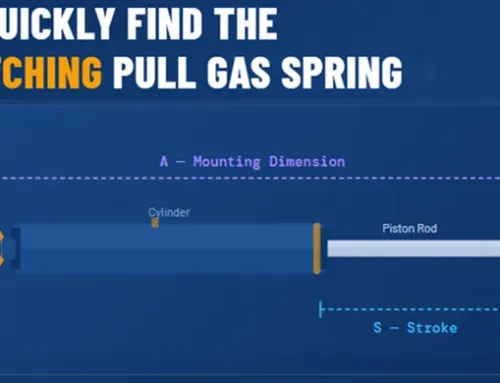
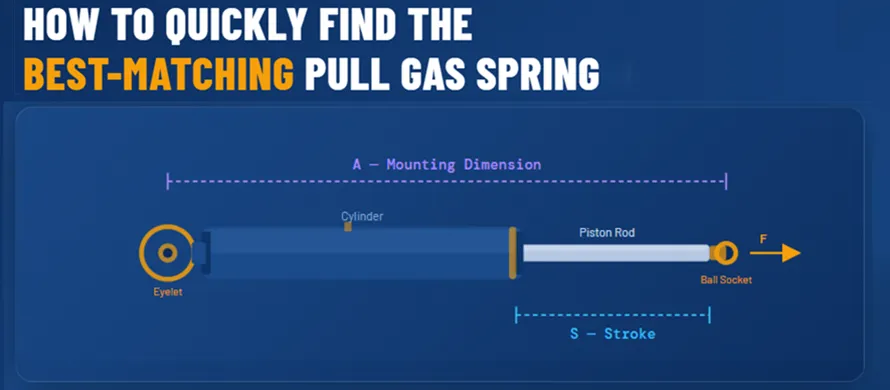
Measure a stainless steel gas spring by recording four key dimensions: extended length (center-to-center length when fully open), stroke (distance the rod travels between open and closed positions), rod diameter (Ø), and tube diameter (Ø). These values define the installation space, strength capacity, and compatibility with your application. Always measure center-to-center of end fittings for accurate replacement or design matching.
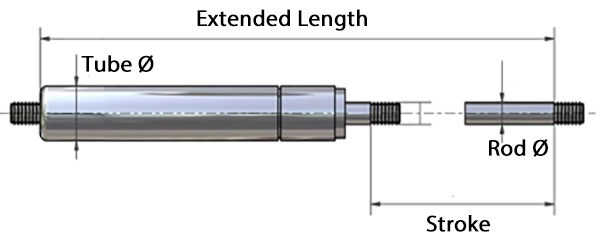
"For detailed step-by-step instructions and to access our interactive sizing calculator, please visit: How to measure a gas strut?
"As a gas spring manufacturer, GASTAC has compiled common client measurement hurdles and provided expert solutions below to help you avoid pitfalls and ensure a precision fit."
Clients often mistakenly measure the absolute tip-to-tip length. You must measure from the center of one end fitting (ball joint or eyelet) to the center of the other when the gas spring is fully extended. Do not include the outer casing of the hardware.
Clients struggle to measure stroke on compressed or stuck springs. The stroke represents only the exposed, polished stainless steel rod when fully open. To find the true specification, you must measure from the edge of the main cylinder to the base of the thread on the rod end.
This is a huge hurdle for clients replacing broken parts. If the spring cannot extend, you must measure the Cylinder Length (the thick body) first. As an engineering rule of thumb, the true stroke is typically slightly less than the cylinder length, allowing you to cross-reference standard size charts.
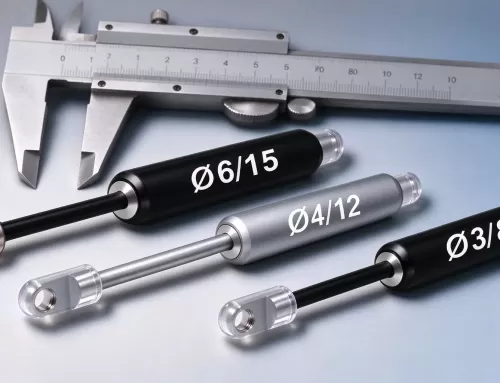
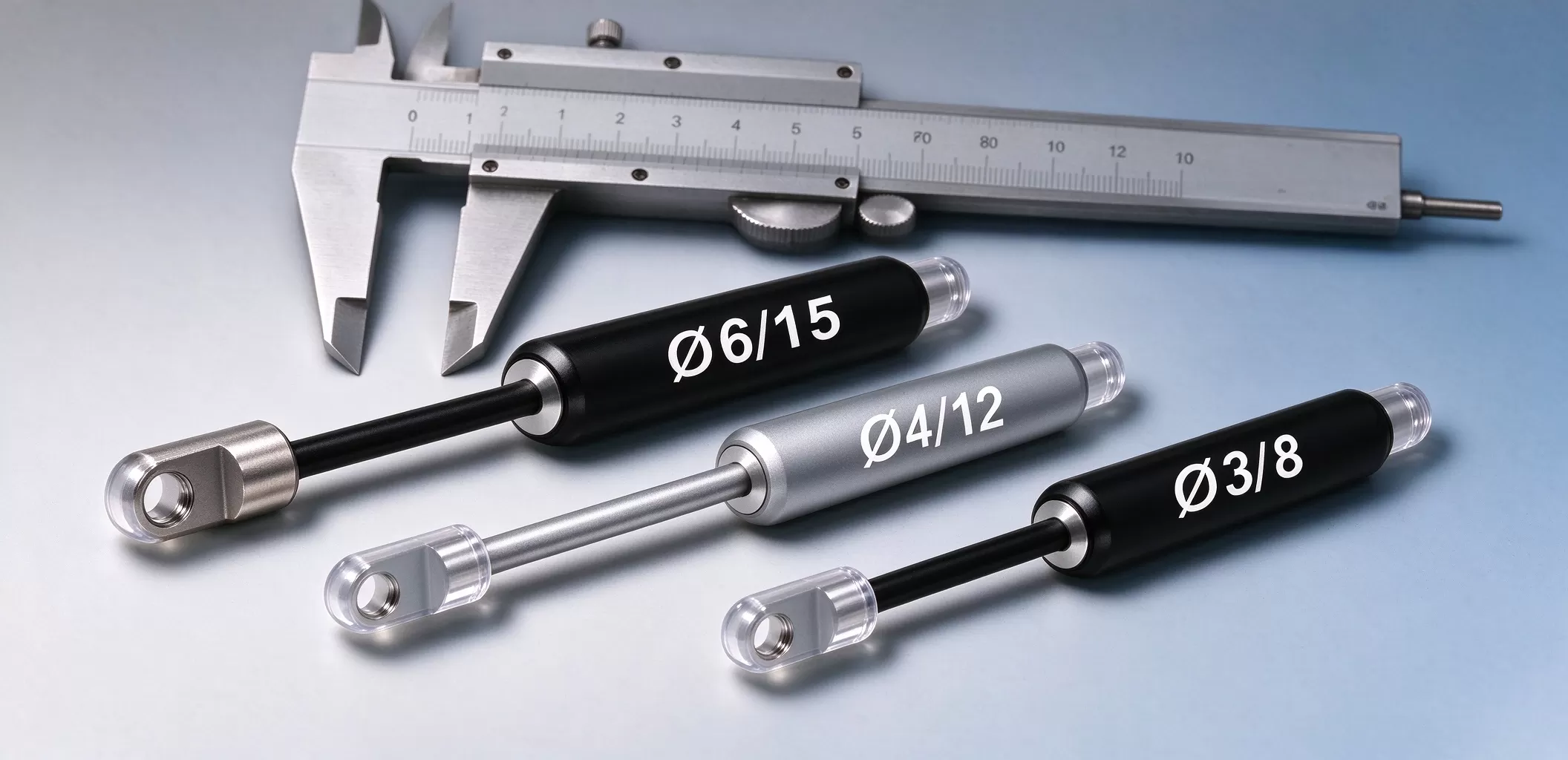
No. Clients often get confused by thread ridges. You must use a caliper to measure the smooth, flat outer diameter of both the black/polished rod (e.g., 8mm) and the main cylinder body (e.g., 18mm). Ignore the thread sizing during this step.
Clients frequently miscalculate this and buy the wrong size. You must strictly measure the gas spring assembly itself, from center-of-fitting to center-of-fitting. Do not include the welded bracket distance, as different end-fittings (clevis, plastic sockets, metal bands) change the clearance required.
How to Calculate Stainless Steel Gas Struts?
To calculate stainless steel gas struts, determine the required force, stroke length, extended length, and mounting angle based on the lid or panel weight. Use the load position, center of gravity, and opening angle to calculate the correct Newton force, ensuring smooth lifting, controlled movement, and long-term stability in harsh environments.
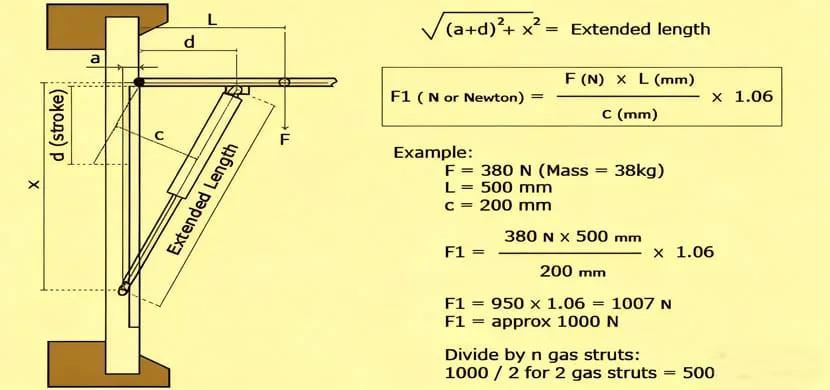
"For the complete step-by-step procedure, please calculate the following parameters in sequential order:"
"As a gas spring manufacturer, GASTAC frequently encounters client questions regarding the operational steps of gas strut calculation. To help you avoid unnecessary hassles, we have compiled and answered these common inquiries below."
This is the most common mathematical pitfall for clients. Gas strut force depends heavily on the lever arm principle. Moving the mounting point closer to the hinge drastically reduces your leverage, meaning the gas strut must output a significantly higher force (F1) to lift the exact same hatch weight.
Clients often mistakenly think the strut force should equal the hatch weight. In reality, because the strut operates at an angle and close to the hinge, it lacks a direct vertical lift. The calculation must account for the gravitational torque of the hatch, which always requires a strut force much higher than the dead weight.
Yes, and clients frequently overlook this. If a marine hatch or cargo door opens outdoors, coastal winds act as an aerodynamic wing, adding massive unexpected loads. Your calculation must include a safety margin (typically 20% to 30% extra force) to prevent the wind from slamming the door shut.
Clients often get confused about how to split the load. If your calculation dictates a total force requirement of 600N for the door, and you install two struts symmetrically, you simply divide the force by two, specifying 300N per strut. This also balances the structural stress on both hinges.
Clients get frustrated when their math fails seasonally. Nitrogen gas pressure drops by approximately 3.5% for every 10°C drop in temperature. If your force calculation was tailored precisely for room temperature without a safety buffer, the strut will lose too much pressure in the cold and fail to lift the hatch.
How to Determine if Stainless Steel Gas Springs Meet Quality Standards?
To ensure delivered gas springs meet industrial standards, verify their physical benchmarks before installation rather than relying on surface aesthetics. Use these five concise technical indicators to audit your products:
- 1PMI Material Verification: Test components with a PMI spectrometer gun to confirm a 2.0%–3.0% molybdenum content. This guarantees genuine 316L marine-grade stainless steel rather than a cheaper, corrosion-prone 304 substitution.
- 2Piston Rod Surface Inspection: Examine the rod under bright light. It must have a mirror-polished, defect-free surface; any microscopic scratches or pits will rapidly tear the internal seals during operation.
- 3
Batch Force (F 1 ) Consistency: Test multiple units from the same delivery batch on a force rig. Premium quality control requires a tight extension force tolerance within ±5% or ±3N.
- 4Seal Integrity Audit: Inspect the cylinder neck where the rod exits the housing. It must be free of heavy oily residue; weeping indicates early seal failure, whereas quality struts utilize a tight double-lip seal to lock in pressure.
- 5End-Fitting Thread Precision: Ensure mounting hardware threads engage smoothly with zero loose play. Fittings must match the exact 316L grade of the cylinder to eliminate galvanic corrosion at joint pivot points.
"As a specialized gas spring manufacturer, GASTAC recognizes that auditing the technical quality of stainless steel gas springs can be complex, often raising critical uncertainties for procurement teams. To streamline your verification process, our engineering team has synthesized the core technical inquiries and provided direct, actionable insights below.""
A microscopic oil film is normal for rod lubrication. However, if you wipe it clean, compress the strut a few times, and visible oil droplets or heavy wet patches reappear, the sealing tightness fails quality standards and will lead to rapid nitrogen leakage.
Inspect the rod under bright directional light. The surface must feature a flawless, mirror-polished finish; if you detect any micro-scratches, pits, or dull grinding lines, the unit is defective, as these imperfections will tear the internal seals during operation.
Industrial-grade standards require high consistency. When sampling multiple units on a force verification rig, the extension force (F1) variance must strictly stay within pm5% or pm3 text; any wider discrepancy indicates unstable factory gas-charging and a QC fail.
Check the thread engagement and casting quality. The end-fittings must thread onto the rod smoothly with zero loose play or wobbling, and the surface must be free of casting pores, micro-cracks, or sharp burrs that could snap under operational vibration.
Clients often suspect a quality issue if they cannot compress the strut by hand. This is a false negative; high-pressure industrial struts with tight internal double-lip seals cannot be compressed by human weight and must be fully installed to utilize the hatch's mechanical leverage.
How to Replace Stainless Steel Gas Struts?
Replacing stainless steel gas struts requires precision to ensure safety and longevity. First, mechanically secure the hatch with a safety prop rod. Never rely on a failing strut to hold heavy loads. Use a flat-head screwdriver to lift the metal retaining clips on the old ball sockets, then pull the strut away from the ball studs. Inspect the mounting hardware for alignment or corrosion. Next, snap the new GASTAC strut onto the studs, ensuring a rod-down orientation to keep the internal seals constantly lubricated. Finally, remove the prop rod and conduct a slow, controlled cycle test to verify smooth operation without hinge binding.
"At GASTAC, we understand that replacing gas springs can present unexpected mechanical hurdles for end-users. To ensure a seamless installation and prevent downtime, we have synthesized and resolved the most critical technical inquiries below."
Mechanically secure the hatch with a safety prop rod first. Then, use a small flat-head screwdriver to slightly pry up the metal retaining clip on the ball socket. This releases tension so the gas strut slides off the ball stud smoothly without forcing or snapping the hardware.
High-pressure industrial gas struts cannot be compressed by human weight due to internal dual-lip seal resistance. Do not attempt to pre-compress them manually; install them directly onto the mounting brackets and use the mechanical leverage of the hatch to compress the cylinder safely.
This indicates side-loading or improper orientation. GASTAC reminds operators to always install struts rod-down in their resting position. This keeps the internal double-lip seals bathed in hydraulic oil, eliminating friction, noise, and premature seal degradation.
Never bend or force the rod, as side-loading will ruin the internal seals. GASTAC designs its gas springs with rotatable end-fittings. Simply grip the cylinder body and gently rotate the ball socket clockwise to achieve the perfect angular alignment needed to snap onto the hardware.
GASTAC strongly recommends inspecting and replacing worn hardware. Mounting a premium, marine-grade 316L stainless steel strut onto an old, rusted carbon steel gas spring bracket will trigger galvanic corrosion, causing premature failure at the joint pivot points.
Why Trust GASTAC as Your Gas Spring Manufacturer?
Trust in industrial manufacturing is built on precision, compliance, and repeatable performance. As a specialized manufacturer, GASTAC bridges the gap between advanced kinematic design and rigorous quality control, ensuring every gas spring meets strict engineering standards. Here is why engineering and procurement professionals worldwide rely on our components for critical applications.
123
123
123
123
123
123
123
123
123
1. Verified Infrastructure & Supply Security
Real Factory Verification: GASTAC is a direct manufacturer with automated production lines and CNC machining centers, supporting factory audits and live video verification to eliminate middleman markups.
- Batch-to-Batch Quality Stability: Strict SPC quality control ensures consistent production accuracy and reliable replacement performance across every shipment.
- Scalable Supply Architecture & Lead Time Predictability: Flexible production supports both custom orders and large OEM projects with stable lead times and dependable global delivery.
- International Certifications & Global Compliance: GASTAC operates under ISO 9001 standards, with CE and RoHS compliant gas spring solutions for international markets.
123
123
123
2. Metallurgical Authenticity & Lifetime Durability
- Metallurgical Authenticity: 100% Verified Marine-Grade 316L: GASTAC uses PMI testing to guarantee genuine 316L stainless steel for superior corrosion resistance in harsh marine and industrial environments.
- Superior Wear Resistance: QPQ Salt Bath Nitriding: Instead of standard chrome plating, GASTAC applies advanced QPQ nitriding to improve surface hardness, reduce friction, and extend service life.
- Advanced Double-Lip Sealing Architecture: GASTAC integrates a high-performance double-lip sealing system with wear rings to prevent gas leakage and block contaminants for long-term force stability.
- Total Cost of Ownership (TCO) Optimization: By reducing premature failures, downtime, and replacement frequency, GASTAC helps lower total ownership costs while protecting long-term equipment reliability.
123
123
123
3. Kinematic Engineering & Technical Value Assets
- Standardized Engineering Assets: GASTAC provides professional engineering support with downloadable 2D/3D CAD models, force curve data, hydraulic damping analysis, and temperature compensation data for extreme operating conditions.
- Kinematic Problem-Solving & Application Expertise: We help analyze load distribution, center of gravity, and operating angles to prevent incorrect force calculations and improve application performance before production.
- Flexible OEM Customization Capabilities: GASTAC supports customized stroke lengths, dimensions, damping speeds, and end fittings for demanding industrial and OEM applications.
- Drop-In Global Interchangeability: Our gas springs are engineered to match major European and American standards, enabling seamless replacement compatibility while reducing inventory complexity.
123
123
123
"In gas spring procurement, selecting the right manufacturer is paramount. To help you mitigate the hidden costs and failure risks of substandard suppliers, GASTAC provides an in-depth analysis of common manufacturing pitfalls and audit blind spots."
To prevent the microscopic scratches on the piston rod that can lead to internal seal failure, GASTAC employs a multi-layered protection system. Each gas spring is encased in an individual plastic sleeve—or, optionally, inserted into a sturdy cardboard tube—and is shipped in reinforced, export-compliant cartons.
GASTAC operates a priority RMA protocol with a 48-hour root-cause analysis upon video/photo review. If a manufacturing defect is confirmed, replacement units are immediately expedited and air-shipped at our expense to eliminate client downtime.
GASTAC manages the production and quality control of all critical end-fittings (ball joints, clevises, eyelets) directly. This ensures all mounting accessories match the exact metallurgical grade and corrosion resistance (such as genuine 316L stainless steel) of the strut body.
Yes. GASTAC fully supports private-label requirements. We provide precision laser-etching for your custom part numbers, logos, and barcodes directly on the cylinder, and can ship in unbranded, neutral packaging for your distribution network.
GASTAC maintains a constant rolling safety stock of premium raw materials and imported seals. Backed by our automated production lines, we have the scalable capacity to absorb sudden volume spikes without bottlenecking your delivery timelines.
Connect with GASTAC on Social Media
Stay connected with our engineering team and procurement network. Follow us across our official digital channels for real-time manufacturing updates, technical insights, and direct support:
LinkedIn: [Follow GASTAC on LinkedIn] — Join our professional B2B network for corporate announcements, supply chain updates, and industrial industry insights.
- YouTube: [Watch GASTAC on YouTube] — Access raw factory floor videos, automated production line demonstrations, and step-by-step product testing protocols.
- Facebook: [Follow GASTAC on Facebook] — Get real-time product releases, community highlights, and quick customer service interaction.
- Reddit: [Join GASTAC on Reddit] — Participate in open engineering forums, share application feedback, and discuss gas spring failure modes or design challenges with peer mechanical designers.
TikTok: [Follow GASTAC on TikTok] — Watch quick, high-impact videos featuring gas spring endurance drop tests, quick installation tips, and satisfying clips of our automated manufacturing and charging processes.
- Instagram: [Follow GASTAC on Instagram] — View high-resolution product showcases, 316L stainless steel material finishes, and behind-the-scenes engineering highlights from our factory floor.
Stay in the loop