







Table of contents
Share Post
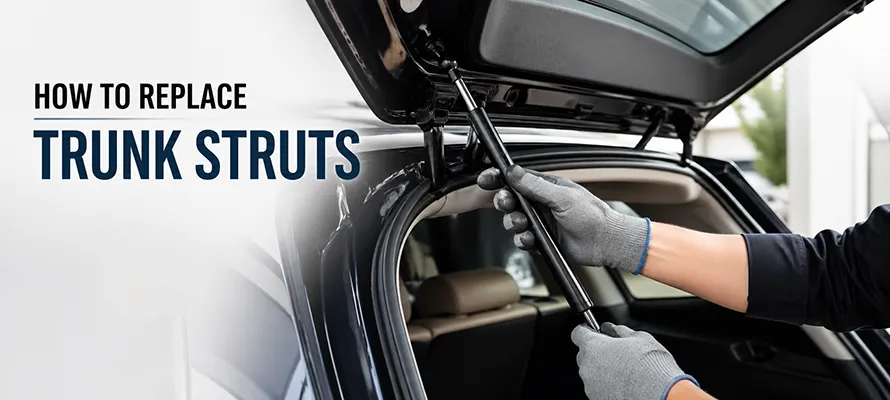
How to Replace Trunk Struts

A trunk that won’t stay open is more than just annoying — it’s a safety risk. If your rear hatch suddenly drops, feels heavy to lift, or no longer holds its position, your trunk struts are likely failing.

Many car owners start searching for how to replace trunk struts, while others look for how to replace trunk shocks or how to replace trunk lift supports. No matter the term, the goal is the same: fix the problem safely and efficiently.

What are trunk struts?

Trunk struts (also known as gas struts or lift supports) are components installed on a vehicle’s trunk or tailgate that support and hold the trunk open, making it easier and safer to access the cargo area.

Do You Really Need to Replace Your Trunk Struts?

Before jumping into replacement, it’s important to confirm whether the issue is actually caused by worn struts. A properly functioning gas strut should provide smooth, controlled lifting and stable support. When it fails, the change is usually noticeable. Common signs of failure include:

  • Trunk won’t stay open and falls suddenly
  • Rear hatch feels unusually heavy
  • Visible oil leakage on the strut body
  • Uneven lifting (one side weaker than the other)

Popular OEM Trunk Strut Cross References

When replacing trunk struts, one of the most important steps is ensuring the correct OEM reference or equivalent specification. Different vehicles require specific length, force, and end fittings. Below are some commonly searched OEM trunk strut references across popular vehicle brands:

GASTAC OEM Replacement Solutions

As a professional GASTAC, we provide direct replacement gas springs that match or exceed OEM specifications. What you get:

  • Precise force calibration
  • Consistent lifting performance
  • Long service life
  • Support for bulk and custom requirements

Whether you’re replacing trunk shocks, trunk lift supports, or standard trunk struts, GASTAC offers reliable solutions across a wide range of vehicle models.

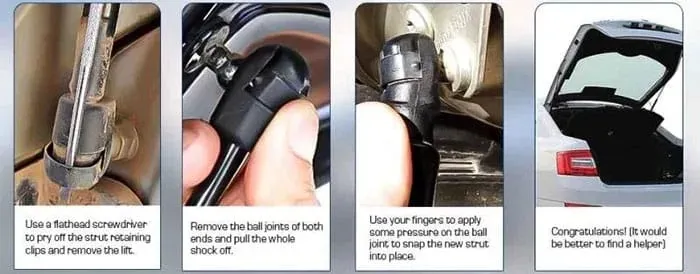
How to Replace Trunk Struts (Step-by-Step)

If you’re learning how to replace trunk lift supports or trunk shocks for the first time, follow these simple steps:

Common Installation Mistakes to Avoid

Even though trunk strut installation is generally straightforward, small mistakes can lead to poor performance, reduced lifespan, or even safety risks.

  • Not supporting the trunk (safety risk)
  • Installing the struts upside down
  • Using incorrect force specifications
  • Replacing only one side

How to Choose the Right Trunk Struts?

Once you understand how to replace trunk struts, the next step is selecting the correct replacement. This is where many users hesitate, because even small specification differences can affect fit, performance, and safety. Key factors to consider:

  • Vehicle compatibility – Ensure the struts are designed specifically for your car model and trunk type
  • Correct force (Newton rating) – Provides the right lifting support; too weak won’t hold, too strong may be hard to close
  • Length and fitting type – Must match the original size and connection style for proper installation
  • End fitting (connector type) – Ball joint, eyelet, or custom ends must match your vehicle’s mounting points
  • Sold as a pair – Ensures balanced lifting force and consistent performance on both sides

Incorrect specifications can lead to poor lifting performance or potential safety issues.

GASTAC Trunk Struts Compatible Vehicle Brands

GASTAC trunk struts are designed to fit a wide range of passenger cars, SUVs, hatchbacks, wagons, and light commercial vehicles. As a professional GASTAC, we provide reliable replacement solutions that cover most mainstream automotive brands and models worldwide. Please check the table below for detailed vehicle brand compatibility.

Audi Hood Struts BMW Hood Struts Buick Hood Struts Cadillac Hood Struts
Chevrolet Hood Struts Chrysler Gas Struts Ford Gas Struts Toyota Gas Struts
Volkswagen Gas Struts Honda Gas Struts Hyundai Gas Struts Nissan Gas Struts
Kia Gas Struts Mercedes-Benz Gas Struts Jeep Gas Struts Volvo Boot Struts
Subaru Gas Struts Dodge Gas Struts Infiniti Gas Struts Mitsubishi Gas Struts

OEM vs Aftermarket – What’s the Difference?

OEM parts are specifically designed for particular vehicle models, ensuring precise fit and original performance—but they are often more expensive and sometimes harder to source. High-quality aftermarket gas springs, such as those from GASTAC, provide a reliable and practical alternative for most users. Advantages include:

  • Direct replacement compatibility – Engineered to match OEM dimensions and mounting points for easy installation
  • Stable and consistent gas pressure – Maintains smooth lifting performance over time without sudden drops
  • Cost-effective solutions – Offers similar performance at a more competitive price compared to OEM parts
  • Wide range of applications – Available for various vehicle models and custom use cases beyond standard replacements

Choosing a trusted aftermarket brand ensures you get both performance and value without compromising safety.

Final Considerations Before Replacement

Learning how to replace trunk struts is one of the easiest and most rewarding DIY car maintenance tasks.

With the right preparation, proper steps, and high-quality replacement parts, you can restore safe and smooth trunk operation in minutes.

For reliable performance and long-term durability, choosing a trusted gas spring manufacturer like GASTAC ensures your replacement is not just easy — but dependable.

张航

Stay in the loop

Subscribe to our free newsletter.

Leave A Comment