









How Can You Quickly Find the Best-Matching Pull Gas Spring for Your Application?

Finding the right pull gas springs for your project can feel like searching for a needle in a haystack—especially when you’re a procurement professional or distributor facing tight deadlines and demanding customers. But what if you could cut through the noise and zero in on the perfect match in minutes?

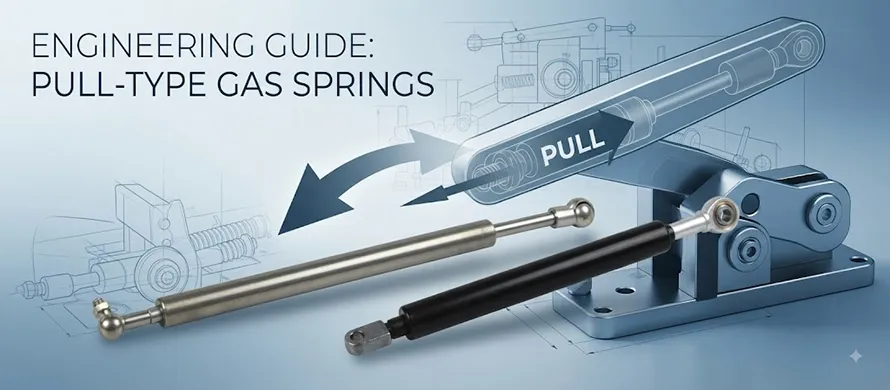
Whether you call them pull gas struts, tension gas springs, or traction gas spring, these specialized components serve one critical purpose: delivering a controlled, consistent pulling force to retract, tension, or close mechanisms safely and smoothly . This guide will walk you through a practical, step-by-step process to find the ideal tension gas spring—fast.

Key Benefits of Pull Gas Springs in your Applications

Pull gas springs are designed to provide controlled pulling force and reliable movement assistance for a wide range of industrial and mechanical applications. With their stable performance, flexible installation options, and customizable design, they help engineers achieve smoother operation, improved efficiency, and optimized mechanical performance. The key benefits of pull gas springs include:

  • Pulling force instead of pushing force
  • Controlled closing or returning movement
  • Compact installation space

Clarify Application Requirements for Pull Gas Springs

The fastest path to the right pull gas strut starts with clarity about what you need. Before browsing catalogs or contacting suppliers, gather answers to these five fundamental questions. This is the “shopping list” for your ideal pull gas spring.

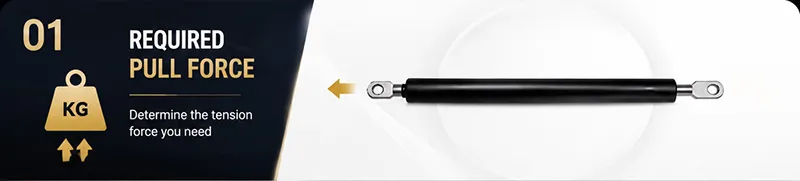
What is the Required Pulling gas Strut force?

This is the non-negotiable starting point. Calculate the load that needs to be pulled or tensioned. Remember: pull gas struts generate tension (they pull inward), unlike standard compression springs that push outward

Pro Tip
As a rule of thumb, when calculating your force requirement, add a safety margin to account for internal friction—typically around 10% of the theoretical load.

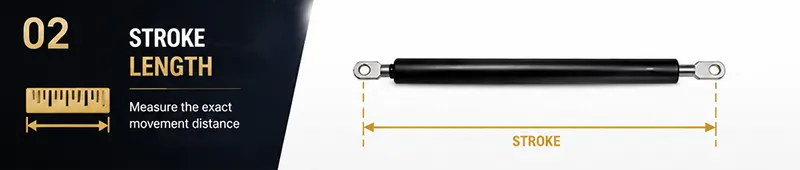
What Pull Gas Struts Stroke Do you Need?

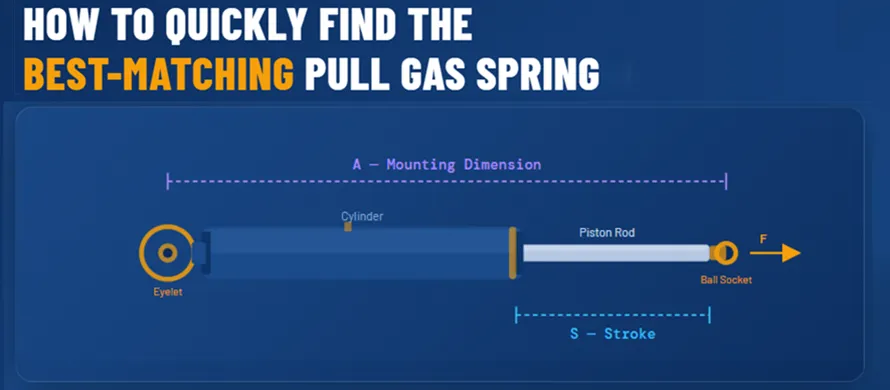
The stroke is the distance the piston rod travels from fully extended to fully compressed. Measure the exact movement distance your application requires—whether it’s a 100mm stroke for a balancer or 500mm for folding treadmill

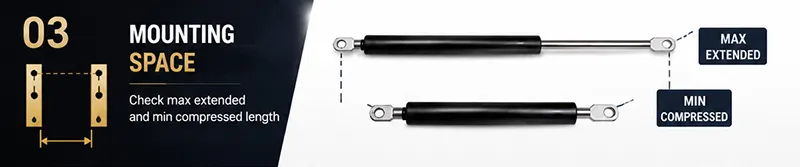
What are your Mounting Space Constraints?

Get precise measurements of:

  • Maximum extended length
  • Minimum compressed length
  • Available mounting points

What is your Operating Environment?

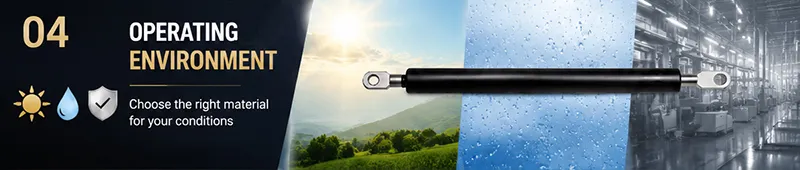
This is critical for material selection. Indoor, dry environments? Standard carbon steel works. Marine, food processing, or medical applications? You’ll need stainless steel (e.g., AISI 304 or 316) for corrosion resistance.

What End Fittings do you Need?

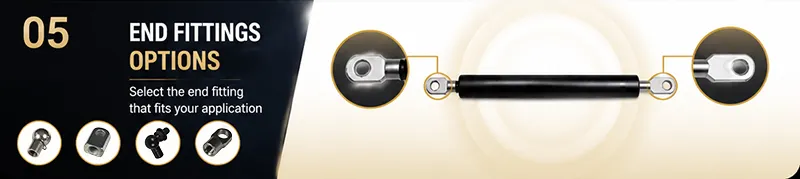
Common options include ball sockets, gas spring eyelets, gas strut ball ends, and clevis joints. Your choice affects both installation ease and overall performance .

Use the Pull Gas Springs Force–Stroke–Length Formula

With your requirements defined, you can quickly narrow down the search by understanding how pulling gas springs are rated.

Pull Gas Struts The Core Formula

The pulling force of a gas spring is determined by its internal pressure and the effective piston area. While suppliers provide this data, a quick sanity check involves:

Required Force (F) = Load × (Moment Arm Ratio) × 1.1 (Safety Factor)

For a simpler approach, most gas spring manufacturers publish force ranges by tube diameter. Common size ranges include :

Tube DiameterRod DiameterTypical Force Range
15mm6mm50 – 400 N
18mm8mm100 – 650 N
22mm10mm150 – 1200 N
28mm14mm200 – 2500 N
Pro Tip
Matching your force requirement to the appropriate diameter range instantly eliminates unsuitable options.

Leverage Pulling Gas Springs Supplier Catalogs and Customization Options

Now it’s time to search pull gas struts. Here’s where to focus your efforts for the fastest results.

Filter by Pulling Gas Springs Key Parameters

Most reputable suppliers—whether on B2B platforms like Alibaba  or specialized engineering sites like MISUMI —allow you to filter pull gas springs by:

  • Force range
  • Stroke length
  • Material (carbon steel vs. stainless steel)
  • End fitting type

Don’t Forget Customization Pull Gas Spring

If standard options don’t match your needs, don’t settle. Leading gas spring manufacturers offer custom engineering services, including

  • Force curve adjustments
  • Extended stroke lengths
  • Specialized end fittings
  • Unique materials for challenging environments

Verify Pulling Gas Springs Quality and Certifications

Speed is worthless without reliability. When evaluating potential suppliers for pull gas struts, ask for:

  • Cycle life test data: Look for gas springs rated for 50,000+ cycles. Some industrial models exceed 100,000 cycles .

  • Material certifications: Ensure components meet standards like ASTM or ISO.
  • Salt spray test: Ensure the supplier provides test results demonstrating corrosion resistance of 144 hours or more.
  • Batch quality: Verify that the supplier’s production batch pass rate is 97% or higher.

Requesting Pull Gas Spring Samples—Try Before You Decide

The quickest way to confirm a match is to test. A reputable supplier should offer sample units. When testing your pulling gas springs, verify:

  • Force profile: Does it feel consistent throughout the stroke?
  • Damping: Does the hydraulic oil provide smooth deceleration at the end of stroke?
  • Mounting fit: Does it install without binding or misalignment?

GASTAC Pull Gas Spring Manufacturer

As a professional pull gas spring manufacturer, GASTAC specializes in providing reliable tension gas spring solutions for industrial equipment, automotive applications, and OEM projects. With extensive experience in gas spring design and manufacturing, we help customers develop the right pull gas springs according to their specific application requirements.

From standard products to fully customized solutions, GASTAC focuses on delivering consistent quality, accurate force performance, and flexible manufacturing capabilities to meet different project needs.

GASTAC Pull Gas Springs Specifications Range

GASTAC offers a comprehensive range of pull gas springs across multiple series to accommodate diverse application requirements. Below are the key specification ranges available—you can use this information to build your own product table.

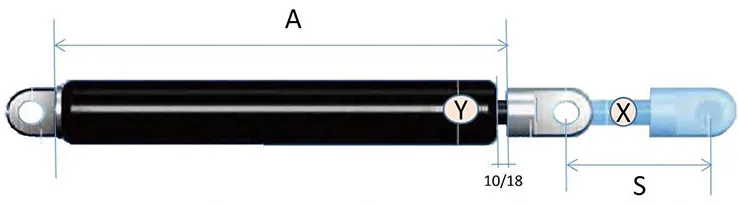
Diameter R/T (mm)S (mm)A (mm)Force (N)
6/1510-150≥S+5040-300
8/1810-200≥S+5640-700
8/2210-300≥S+5640-700
10/2210-300≥S+6680-10000
10/2410-300≥S+6680-10000
12/2410-300≥S+70100-1300
12/2810-300≥S+70200-1700

GASTAC Pull Gas Springs Best-selling Products

GASTAC offers a comprehensive range of pull gas springs designed to meet diverse application requirements across multiple industries. Our best-selling models are summarized below—you can use this information to create your own product table.

Benefits of GASTAC Tension Gas Springs

GASTAC tension gas springs are engineered to deliver reliable, high-performance pulling force across a wide range of applications. Built with precision manufacturing and rigorous quality control, they offer outstanding durability, consistency, and customization flexibility to meet your specific requirements. The key benefits of pull gas springs include:

  • Premium Materials: The cylinder is manufactured using high-strength carbon steel and precision seamless steel tubing.
  • Advanced Processing: The piston rod undergoes hard chrome plating for enhanced wear and corrosion resistance.
  • Long Life Cycle: Rated for 150,000 to 200,000 cycles, certified by SGS.
  • Wide Force Range: From 50N to 2,400N, suitable for various applications.
  • Stroke Range: From 25mm to 500mm, offering flexibility in design.
  • Corrosion Resistance: Tested with up to 200 hours of salt spray exposure.
  • Temperature Tolerance: Usable within a wide temperature range of -30°C to 80°C.

Benefits of GASTAC Factory

When you choose GASTAC as your pull gas spring supplier, you’re partnering with a manufacturer that combines decades of engineering expertise with a commitment to quality, precision, and customer satisfaction. Here’s what sets GASTAC apart:

  • With a proven track record of serving over 500 medical industry clients, we have established long-term partnerships with leading brands.
  • Factory scale with over 1000 m² production facility and 100+ employees, including engineering, production, and quality control teams
  • Compliance with international quality and safety standards (e.g., ISO certification)
  • Production capacity of 5,000 pull gas springs every two weeks.
  • Strict tolerance control for consistent force output across production batches (Error within 0.2%)
  • Verified cycle life testing and durability performance reports.
  • Services such as labeling, packaging, private labeling, and agency representation are supported.

  • Reliable after-sales service and technical support for long-term cooperation

How to Quickly Get the Right Pull Gas Springs for Your Project

To quickly get the right pull gas springs for your project, simply provide the following key details to your supplier. With these parameters, an experienced manufacturer can immediately recommend or customize the most suitable solution for your application.

  • Required pulling force (N or lbs)
  • Stroke
  • Extended length
  • Installation dimensions
  • Gas spring mounting type
  • Operating temperature
  • Application details or product drawings

Final Get A quote Now

Finding the best-matching pull gas spring doesn’t need to be a drawn-out process. By defining your requirements upfront, understanding how force and stroke interact, and using supplier filters effectively, you can narrow down your options in minutes—not days.

Ready to find your perfect tension gas spring? Contact GASTAC engineering team today for a free selection consultation. We’ll help you match the exact specifications for your application, so you can order with confidence.

Stay in the loop

Subscribe to our free newsletter.