📋 CONTENTS — Pull Type Gas Spring Engineering Guide
Pull type gas springs are mission-critical for controlled tension and fail-safe retraction. Yet many engineers misapply compression springs to pulling tasks, resulting in poor performance and reduced service life. This engineering resource from GASTAC — a premier manufacturer of pull type gas strutsand gas springs pull type — delivers the technical clarity you need to select, specify, and source with confidence.
1. What Is a Pull Type Gas Spring? Definition of Pull Type Gas Struts
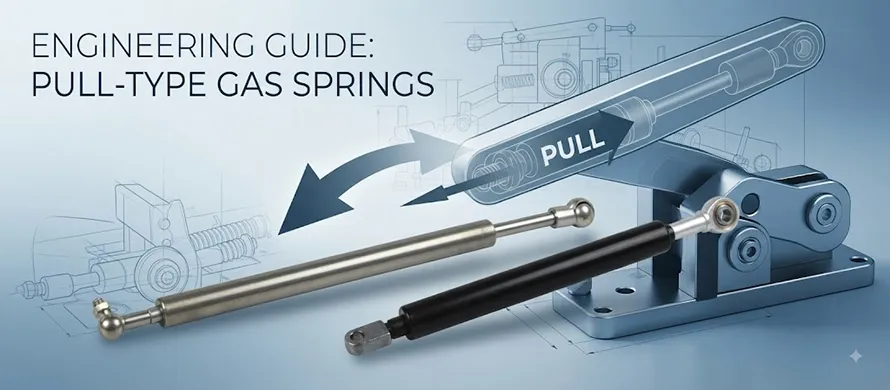
A pull type gas spring (widely specified as a pull type gas strut, tension gas spring, or traction gas spring) is a nitrogen-charged, self-contained actuator that delivers a controlled pulling force over a defined stroke.
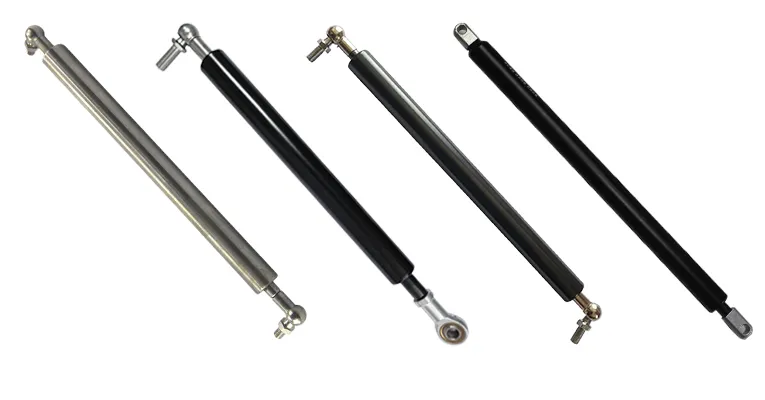
Defining characteristic: In its resting state, the piston rod is fully retracted into the cylinder. When an external force extends the rod, the internal gas pressure generates a resistive pull that returns the rod to its retracted position upon release — the inverse of a compression gas spring.
Critical engineering note: A pull type gas spring is not a compression spring installed backwards. The internal valving, seal geometry, piston design, and gas porting are fundamentally different.
Common Industry Synonyms for Pull Type Gas Springs
| Term | Usage Context |
|---|---|
| Pull type gas spring | Most common general term |
| Pull type gas strut | Frequently used in automotive & industrial |
| Tension / Traction gas spring | Common in European engineering docs |
| Gas springs pull type | Standard search and catalog keyword |
| Reverse-acting gas strut | Emphasises opposite action to compression |
2. Pull Type Gas Spring Engineering Principles: How It Works
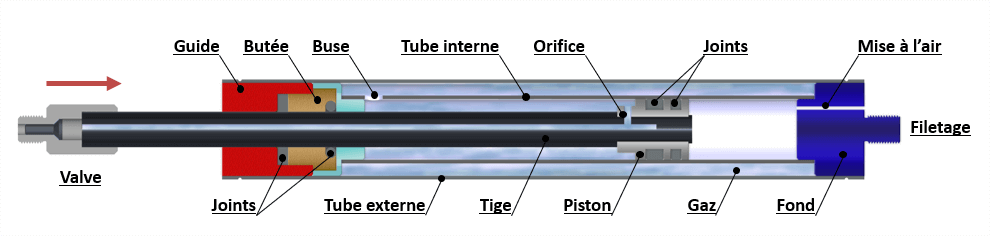
2.1 Internal Construction of Pull Type Gas Struts
| Component | Function |
|---|---|
| Pressure cylinder | Sealed chamber containing high-pressure nitrogen gas and damping oil |
| Piston assembly | Moves within the cylinder, separating gas and oil chambers |
| Piston rod (hard-chromed / SS) | Transmits the pulling force |
| Dynamic seals & guide bearings | Maintain gas containment; ensure smooth rod travel |
| Damping oil | Provides controlled velocity and end-of-stroke cushioning |
2.2 Pull Type Gas Spring Operating Cycle
Phase 1 (Resting): Rod retracted. Nitrogen pressure (typically 60–150 bar) acts on the piston area, keeping the rod fully retracted without external force.
Phase 2 (Extension): External force pulls the rod outward. Gas volume increases, pressure drops slightly; damping oil flows through metered orifices for controlled velocity.
Phase 3 (Retraction): External force removed. Gas pressure forces the rod back in; oil meters through the piston for a smooth, predictable return stroke.
Flat force curve: Pull type gas springs exhibit near-constant force throughout the stroke, with a slight positive progression at full extension — a key advantage over mechanical springs.
3. Pull Type Gas Spring vs. Compression: Critical Selection Criteria
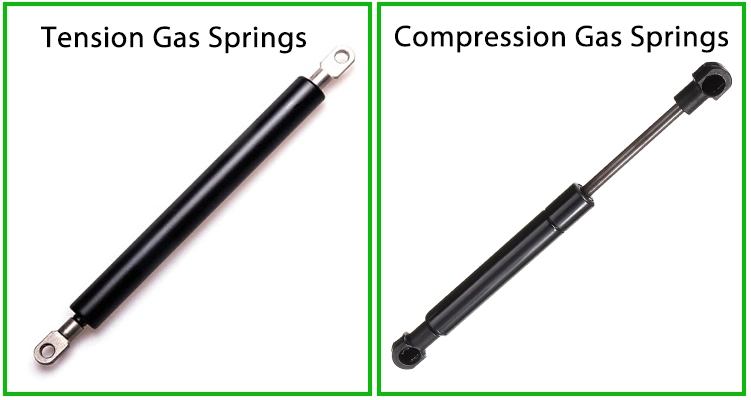
| Parameter | Pull Type Gas Spring | Compression Gas Spring |
|---|---|---|
| Resting state | Rod retracted | Rod extended |
| Force direction | Pulling (inward) | Pushing (outward) |
| Typical applications | Closing, retracting, tensioning | Lifting, supporting, opening |
| Fail-safe condition | Closed (rod retracts on failure) | Open (rod extends on failure) |
| Space requirement | Compact mounting envelope | Requires clearance for rod extension |
Pull Type Gas Spring Selection Decision Logic
- Step 1: Mechanism requires pulling force? → Proceed. If pushing → choose compression.
- Step 2: Mechanism is most compact when unloaded? → Pull type gas spring is correct.
- Step 3: Fail-safe closure required? → Pull type gas strut is mandatory.
Example: Machine Guard Covers — Compression springs would push the guard open (hazard). A gas springs pull type keeps the guard closed when not in use, assists smooth closure, and ensures fail-safe operation.
4. Technical Specifications for Pull Type Gas Springs: What to Specify
4.1 Force (F1 Value) for Pull Type Gas Springs
F1 is the standard industry notation for extension force (typically measured at 20 mm from full compression). Manufacturing tolerance is ±5–10% of nominal F1.
Do not over-specify force. Excessive force increases operator effort, accelerates seal wear, over-stresses brackets, and adds unnecessary cost
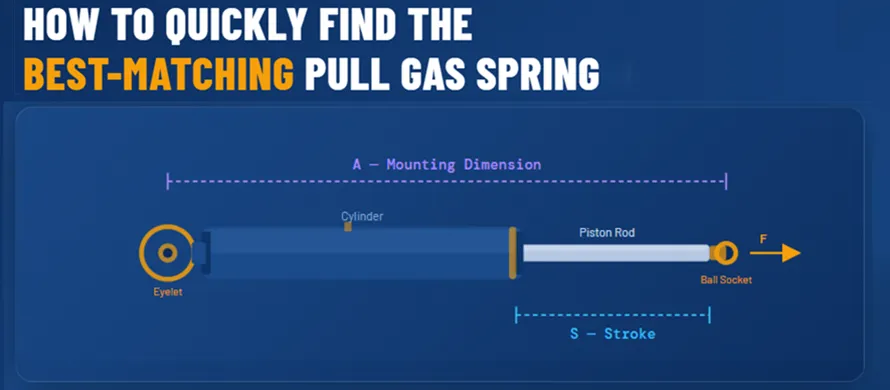
4.2 Pull Type Gas Spring Stroke Length
Stroke must be at least equal to required travel, and preferably 10–15% greater to accommodate tolerances.
4.3 Extended & Compressed Lengths for Pull Type Gas Struts
- Lmax (extended): Must fit within max clearance envelope.
- Lmin (compressed): Must fit within min clearance envelope.
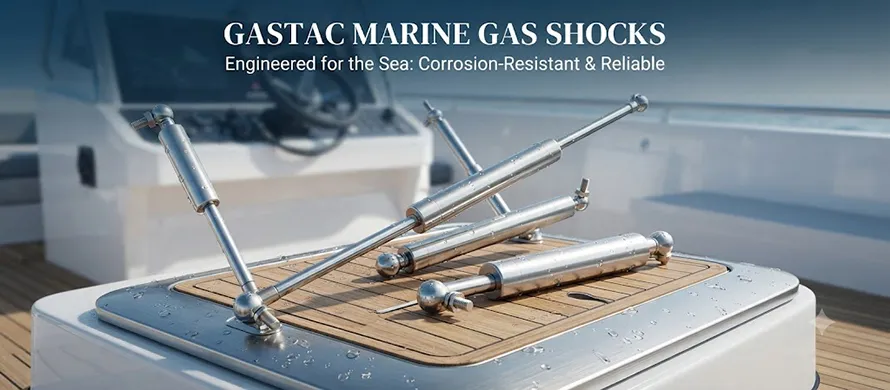
4.4 Environmental Conditions for Pull Type Gas Springs
| Condition | Consideration |
|---|---|
| Temperature range | Standard: -30°C to +80°C; Custom: -40°C to +120°C |
| Corrosive environment | Specify stainless steel (AISI 304/316L) or QPQ coating |
| Dust / debris | Consider rod covers or wiper seals |
| Service life | Standard 100,000 cycles; 200,000+ with premium seals |
5. Pull Type Gas Spring Applications Engineering
🏭 Industrial Equipment
- Machine safety guards (fail-safe closure)
- Inspection access panels
- Conveyor covers & control cabinets
🏥 Medical Equipment
- Examination tables & dental chairs
- Surgical equipment (clean-room compatible)
- Patient lifting devices
🚗 Automotive & Transport
- Sunroof systems (pulls glass tight)
- Toolboxes, truck caps & engine covers
- Trunk lid separators
🪑 Furniture & Specialty
- Drop-down wardrobes & overhead storage
- Display cases (silent operation)
- Drawer retraction systems
6. GASTAC Pull Type Gas Spring Engineering Capabilities
6.1 Pull Type Gas Spring Product Range (GTC Series)
GASTAC manufactures a complete line of pull type gas springs covering a broad specification range. The following GTC series products are available with custom options:
| Product Code | Rod Ø (mm) | Tube Ø (mm) | Stroke (mm) | Extended Length | Force (F1) |
|---|---|---|---|---|---|
| GTC0615 | 6 | 15 | 30–300 | 2×Stroke + 85 mm | 100–500 N |
| GTC0818 | 8 | 18 | 30–400 | 2×Stroke + 85 mm | 100–700 N |
| GTC1024 | 10 | 24 | 30–500 | 2×Stroke + 100 mm | 150–1,000 N |
| GTC1428 | 14 | 28 | 50–500 | 2×Stroke + 100 mm | 500–3,500 N |
For detailed specifications of each specific model, please refer to the 10‑22 series table below or contact our engineering team.
6.2 Pull Type Gas Spring Detailed Product Specifications – 10‑22 Series
The following table lists all standard 10‑22 series pull type gas struts available from GASTAC.
| Product Code | Rod Ø | Body Ø | Stroke | Extended Length | Force Range (lbs) | Body Thread Size |
|---|---|---|---|---|---|---|
| GST102241046 | 10 mm (0.39 in) | 22.10 mm (0.87 in) | 139.70 mm (5.50 in) | 410.46 mm (16.16 in) | 25‑300 | M8x1.25 |
| GST102238633 | 10 mm (0.39 in) | 22.10 mm (0.87 in) | 139.70 mm (5.50 in) | 386.33 mm (15.21 in) | 25‑300 | M8x1.25 |
| GST102240640 | 10 mm (0.39 in) | 22.10 mm (0.87 in) | 139.70 mm (5.50 in) | 406.40 mm (16.00 in) | 25‑300 | M8x1.25 |
| GST102233426 | 10 mm (0.39 in) | 22.10 mm (0.87 in) | 88.90 mm (3.50 in) | 334.26 mm (13.16 in) | 25‑300 | M8x1.25 |
| GST102231013 | 10 mm (0.39 in) | 22.10 mm (0.87 in) | 88.90 mm (3.50 in) | 310.13 mm (12.21 in) | 25‑300 | M8x1.25 |
| GST102233020 | 10 mm (0.39 in) | 22.10 mm (0.87 in) | 88.90 mm (3.50 in) | 330.20 mm (13.00 in) | 25‑300 | M8x1.25 |
| GST102228346 | 10 mm (0.39 in) | 22.10 mm (0.87 in) | 76.20 mm (3.00 in) | 283.46 mm (11.16 in) | 25‑300 | M8x1.25 |
| GST102225933 | 10 mm (0.39 in) | 22.10 mm (0.87 in) | 76.20 mm (3.00 in) | 259.33 mm (10.21 in) | 25‑300 | M8x1.25 |
| GST102227940 | 10 mm (0.39 in) | 22.10 mm (0.87 in) | 76.20 mm (3.00 in) | 279.40 mm (11.00 in) | 25‑300 | M8x1.25 |
| GST102221996 | 10 mm (0.39 in) | 22.10 mm (0.87 in) | 57.15 mm (2.25 in) | 219.96 mm (8.66 in) | 25‑300 | M8x1.25 |
| GST102219583 | 10 mm (0.39 in) | 22.10 mm (0.87 in) | 57.15 mm (2.25 in) | 195.83 mm (7.71 in) | 25‑300 | M8x1.25 |
| GST102262890 | 10 mm (0.39 in) | 22.10 mm (0.87 in) | 254.00 mm (10.00 in) | 628.90 mm (24.76 in) | 25‑300 | M8x1.25 |
| GST102260884 | 10 mm (0.39 in) | 22.10 mm (0.87 in) | 254.00 mm (10.00 in) | 608.84 mm (23.97 in) | 25‑300 | M8x1.25 |
| GST102263297 | 10 mm (0.39 in) | 22.10 mm (0.87 in) | 254.00 mm (10.00 in) | 632.97 mm (24.92 in) | 25‑300 | M8x1.25 |
| GST102275108 | 10 mm (0.39 in) | 22.10 mm (0.87 in) | 317.50 mm (12.50 in) | 751.08 mm (29.57 in) | 25‑300 | M8x1.25 |
| GST102277114 | 10 mm (0.39 in) | 22.10 mm (0.87 in) | 317.50 mm (12.50 in) | 771.14 mm (30.36 in) | 25‑300 | M8x1.25 |
| GST102277521 | 10 mm (0.39 in) | 22.10 mm (0.87 in) | 317.50 mm (12.50 in) | 775.21 mm (30.52 in) | 25‑300 | M8x1.25 |
| GST102253746 | 10 mm (0.39 in) | 22.10 mm (0.87 in) | 203.20 mm (8.00 in) | 513.33 mm (20.21 in) | 25‑300 | M8x1.25 |
| GST102253340 | 10 mm (0.39 in) | 22.10 mm (0.87 in) | 203.20 mm (8.00 in) | 533.40 mm (21.00 in) | 25‑300 | M8x1.25 |
| GST102241626 | 10 mm (0.39 in) | 22.10 mm (0.87 in) | 152.40 mm (6.00 in) | 461.26 mm (18.16 in) | 25‑300 | M8x1.25 |
| GST102243713 | 10 mm (0.39 in) | 22.10 mm (0.87 in) | 152.40 mm (6.00 in) | 437.13 mm (17.21 in) | 25‑300 | M8x1.25 |
For custom stroke lengths, force values, or end fittings, please contact our engineering team.
6.3 Pull Type Gas Spring Manufacturing Standards
GASTAC maintains rigorous quality management systems to ensure every pull type gas strut meets the highest industry standards:
- IATF 16949:2016 & ISO 9001:2015 — audited annually
- 100% final inspection (every unit performance-tested)
- 100,000-cycle durability validation (standard)
- 200+ hour salt spray resistance (ASTM-B117 with QPQ)
- 2-year comprehensive warranty
7. Pull Type Gas Strut Installation for Long-Term Reliability
Mandatory: Install with the piston rod facing downward whenever possible. This ensures the rod seal remains lubricated, reducing friction and stick-slip, and extending service life.
Mounting point geometry: Ensure that in the closed position, the pull type gas strut has passed the mechanical centerline — otherwise it will pull the mechanism open instead of holding it closed.
Piston rod protection: The rod is a precision-ground surface (Ra 0.2–0.4 µm). Do not paint or coat it — surface damage compromises seal integrity and leads to gas leakage.
8. Pull Type Gas Springs Market Landscape & Trends
📈 Market Growth
- 2025: USD 1.66 Bn
- 2035 (projected): USD 2.50 Bn
- CAGR: 4.2%
⚡ Key Demand Drivers
- Industrial automation & robotics
- Medical device innovation
- EV battery covers & charging ports
- Aerospace lightweight actuation
9. Why Source Pull Type Gas Springs from GASTAC?
| Capability | GASTAC Advantage |
|---|---|
| Experience | 20+ years focused on pull type gas springs |
| Quality | IATF 16949 / ISO 9001:2015, 100% inspection |
| Customization | Full in-house OEM/ODM — force, stroke, fittings, materials |
| Global reach | Exports to Europe, Americas, SE Asia, Korea, Australia, Russia, South Africa |
| Support | Pre-sales engineering + post-sales warranty |
10. Summary: Making the Right Pull Type Gas Spring Specification
- Force direction: Pulling → pull type gas spring; Pushing → compression.
- Envelope: Compact space → pull type gas strut preferred.
- Safety: Fail-safe closure → gas springs pull type.
Pull Type Gas Spring Specification Checklist
- [ ] F1 force (N/lbs) [ ] Stroke (mm/in) [ ] Lmax / Lmin
- [ ] End fitting type & dimensions
- [ ] Temperature range & corrosion resistance
- [ ] Cycle life requirement & mounting orientation
Let's Engineer Your Pull Type Gas Spring Solution
Whether you need a standard pull type gas spring or a fully custom pull type gas strut for a unique application, GASTAC's engineering team is ready to assist — from concept to production.
- Technical consultation & force calculation
- Custom prototyping & validation testing
- Volume production with full traceability
- Global logistics & after-sales support
Stay in the loop