




Table of contents
Share Post

To the untrained eye, a marine gas spring appears to be a passive steel rod that effortlessly lifts heavy engine hatches, boat doors, or storage bays. However, unlike traditional mechanical coil springs that rely on metal deformation, a gas spring is a highly sophisticated, closed-loop pneumatic system.

It does not generate force by being “elastic”; it generates force through precise internal pressure differentials and fluid dynamics.

Here is an engineering breakdown of exactly how the internal components of a marine gas spring work together to generate continuous lifting force.

1. The Core Physics: Piston Rod Area Differential

The baseline lifting force of a gas spring is governed by a simple principle of physics: pressure multiplied by area (F = P × A).

Inside the sealed cylinder, the chamber is factory-charged with high-purity, inert nitrogen gas ($N_2$). This gas fills the spaces on both sides of the internal piston head. Because the gas can flow freely through tiny channels (orifices) in the piston head, the internal pressure (P) remains equal throughout the entire cylinder.

However, a critical imbalance exists:

  • Side A (Behind the Piston): The gas pushes against the full cross-sectional area of the piston head.
  • Side B (In Front of the Piston): The gas pushes against the piston head minus the area occupied by the solid steel rod.

Because the surface area on Side A is larger than the available surface area on Side B, the equal gas pressure exerts a greater total force on the back of the piston. This area differential creates a permanent net force that constantly pushes the piston rod outward, generating the characteristic lifting force.

2. Volumetric Displacement and Constant Force Profile

When you close a boat hatch, you force the piston rod into the cylinder. As the rod enters the chamber, it occupies physical space, reducing the available internal volume (V) left for the gas.

According to the Ideal Gas Law (PV = nRT), compressing this volume causes the internal pressure (P) to rise. However, because the rod’s diameter is engineered to be relatively small compared to the total volume of the cylinder, the volume change is minimal.

This results in a remarkably flat force profile. Unlike a wire coil spring—which doubles its resistance the further you compress it—a gas spring’s lifting force increases only slightly (typically between 10% to 40%) from full extension to full compression. This provides smooth, predictable support throughout the entire opening and closing cycle.

3. The Critical Marine Components: Sealing and Gas Purity

In a harsh saltwater environment, standard internal components fail instantly. To maintain lifting force over years of exposure, marine-grade gas springs rely on specialized internal engineering:

  • High-Purity Nitrogen (99.99%): The cylinder is filled with pure, dry nitrogen. Any internal moisture or ambient air would cause internal condensation, leading to oxidation of the polished rod and sudden pressure drop.
  • Double-Lip Scraper Seals: To keep the high-pressure gas locked inside, marine springs utilize advanced elastomer seals (typically Viton or high-grade Nitrile). The outer lip acts as a scraper to wipe salt crystals and moisture off the rod during compression, preventing debris from migrating into the high-pressure chamber and tearing the main gas seal.
  • Internal Micro-Hydraulic Oil: Along with the gas, a precise volume of synthetic hydraulic oil is sealed inside. This oil serves two purposes: it keeps the internal seals permanently lubricated so they do not dry out, and it pools at the bottom of the stroke to provide hydraulic end-damping, slowing down the rod right before full extension to prevent structural jarring.

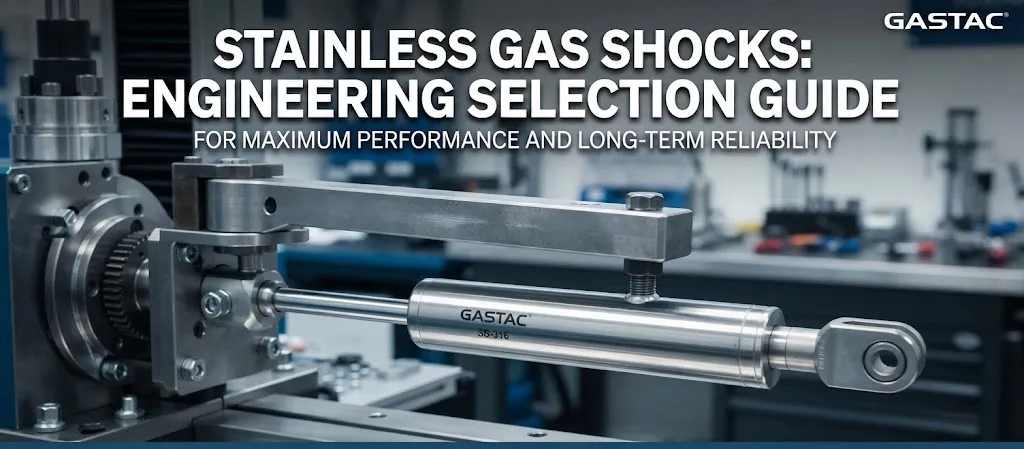
When configuring these internal dynamics for specific hull designs, calculating load distribution and reviewing the factors to consider when selecting stainless steel gas shocks ensures that your internal sealing system operates within its optimal performance parameters.

Technical Internal Breakdown Summary

  • Nitrogen Gas (N2): Provides the energy medium and constant internal pressure.
  • Piston Rod: The component whose physical volume creates the area differential needed for outward force.
  • Piston Head Channels: Allows gas to equalize on both sides of the chamber, ensuring the rod area dictates the movement.
  • Internal Oil: Lubricates seals and handles kinetic deceleration at the end of the stroke.

Final Engineering Verdict

A marine gas spring generates lifting force not by pulling or mechanical tension, but by utilizing internal pneumatic pressure against an asymmetrical surface area. When built with high-purity nitrogen, specialized double-lip seals, and corrosion-resistant alloys, this internal system delivers consistent, smooth, and reliable lifting force capable of defying gravity in the toughest marine environments.

张航

Stay in the loop

Subscribe to our free newsletter.

Leave A Comment