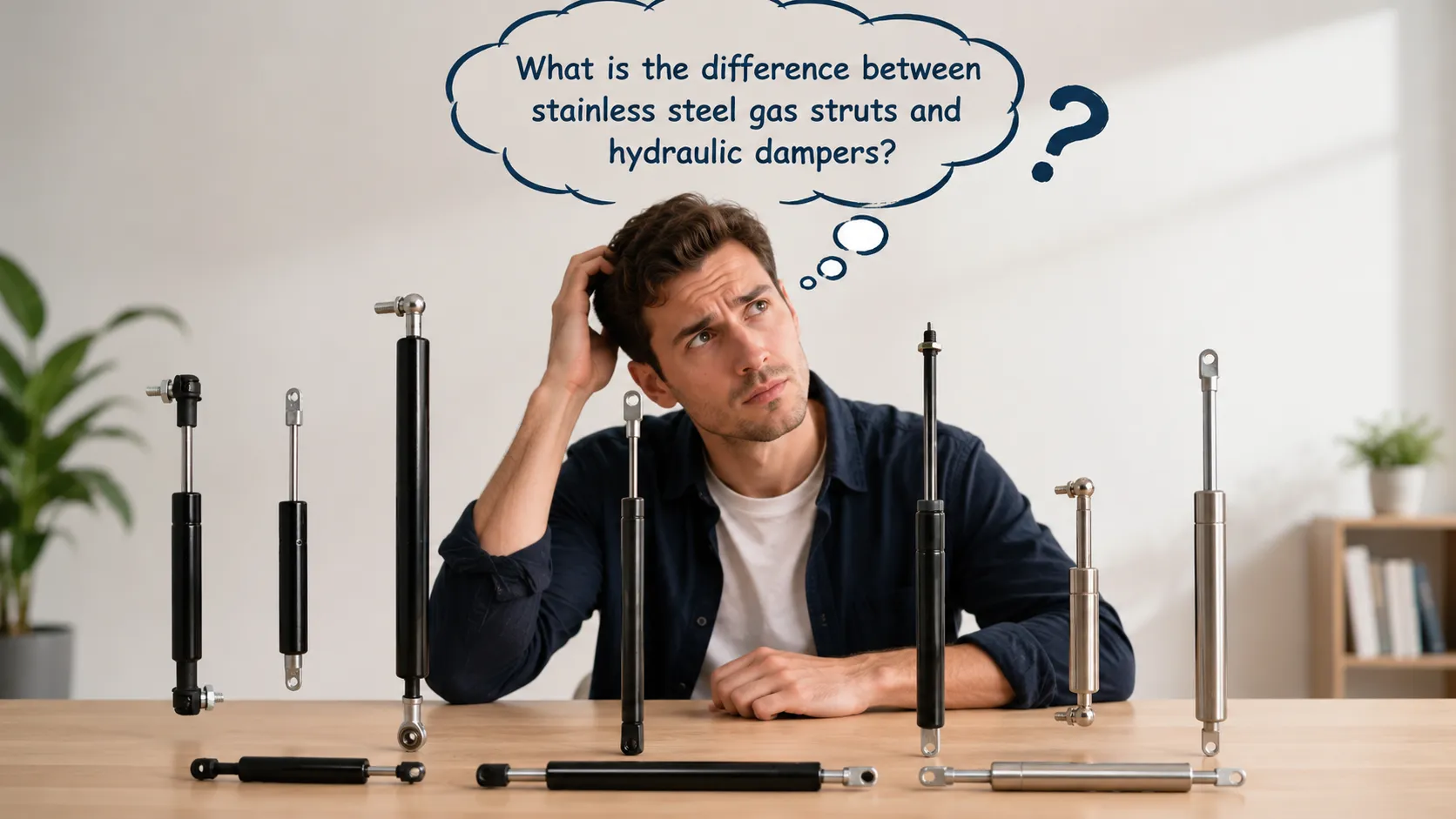



In mechanical engineering, stainless steel gas struts and hydraulic dampers look almost identical from the outside. Both feature a sleek metallic cylinder, a smooth piston rod, and internal fluid mechanics. However, their internal designs and mechanical purposes are complete opposites. One is designed to push, while the other is designed to resist.
Understanding this fundamental distinction prevents critical design failures in motion control systems.
1. The Core Mechanical Function
The absolute variance between these two components lies in how they handle energy.
Stainless Steel Gas Strut (Energy Storage): A gas strut acts like a powerhouse. It is pre-charged with high-pressure nitrogen gas. When you compress the rod, you store energy. When released, the gas expands and forces the rod outward. It acts as a lift-assist or counter-balance, delivering continuous lifting force.
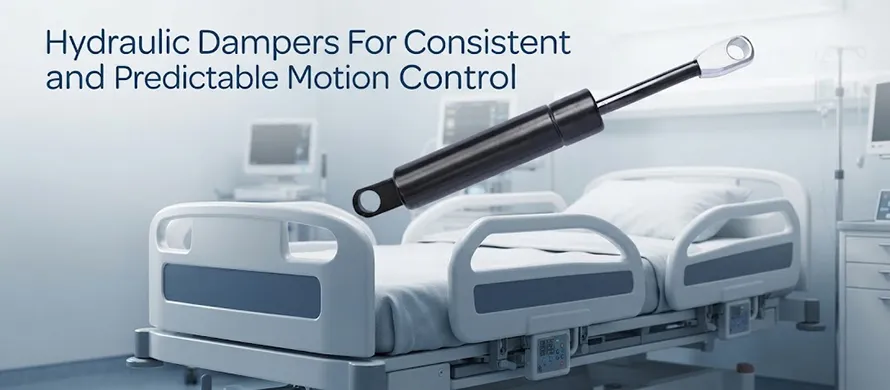
Hydraulic Damper (Energy Dissipation): A damper does not store energy, and it cannot lift anything. It is filled entirely with hydraulic oil. Its only job is to absorb kinetic energy and convert it into heat. It controls velocity by providing mechanical resistance to movement, ensuring things move slowly and smoothly.
2. Force Generation: Displacement vs. Velocity
How these components generate their force depends on completely different physical variables.
Gas Struts depend on position. The outward force is determined by internal gas pressure and rod volume displacement. Whether you move the rod fast or slow, the pushing force remains virtually constant at any given point of its stroke.
- Hydraulic Dampers depend on speed. A damper only generates force when it is actively moving. If you pull or push a damper slowly, you will feel very little resistance. If you try to pull or push it rapidly, the resistance spikes dramatically. When stationary, a damper exerts zero force.
3. Structural Differences Table
While both rely on tight sealing profiles to prevent fluid migration, their internal hardware differs:
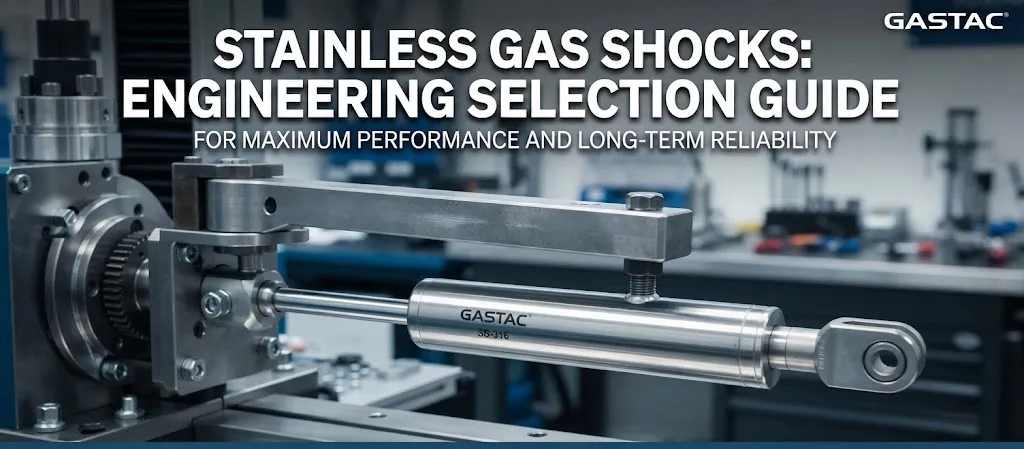
- Gas Struts: Chambered with high-pressure nitrogen gas, paired with a small amount of oil for end-of-stroke deceleration and seal lubrication. Grade 304 or 316L stainless steel housing protects these high-pressure internal mechanics from corrosive environments.
- Hydraulic Dampers: Completely packed with hydraulic fluid. They utilize precise internal valving (orifices) on the piston head to meter oil flow, adjusting resistance independently in extension, compression, or both directions.
When engineers specify these high-pressure components for corrosive or heavy-duty setups, reviewing the complete factors to consider when selecting stainless steel gas shocks is a vital step to prevent premature seal wear.
4. Quick Comparison
| Feature | Stainless Steel Gas Strut | Hydraulic Damper |
|---|---|---|
| Primary Action | Active Lifting / Pushing Force | Passive Resistance / Speed Control |
| Internal Medium | High-pressure Nitrogen gas + Oil | 100% Hydraulic Oil |
| Force Source | Position (Gas compression) | Velocity (Fluid shear through orifices) |
| Force when Stopped | Maintains full pushing force | Zero force |
Final Engineering Verdict
Use a stainless steel gas strut if your objective is to make a heavy lid, hatch, or panel feel light and stay open safely.
Use a hydraulic damper if your mechanism already moves under its own weight or external force, but you need to prevent it from slamming, dropping too fast, or vibrating violently.
张航
Stay in the loop