


Table of contents
Share Post

In industrial engineering, few things are more frustrating than tension gas springs that perform perfectly during installation but “gets soft” after only a few months of service. This results in heavy hatches that won’t stay closed or mechanical doors that fail to retract fully.

This instability in force is rarely a matter of luck; it is a matter of physics and engineering standards. In this guide, we dive deep into why tension gas spring (also known as tension gas strut) lose their pull force and how professional buyers can audit suppliers to ensure long-term reliability.

The Engineering Showdown: Tension vs. Compression

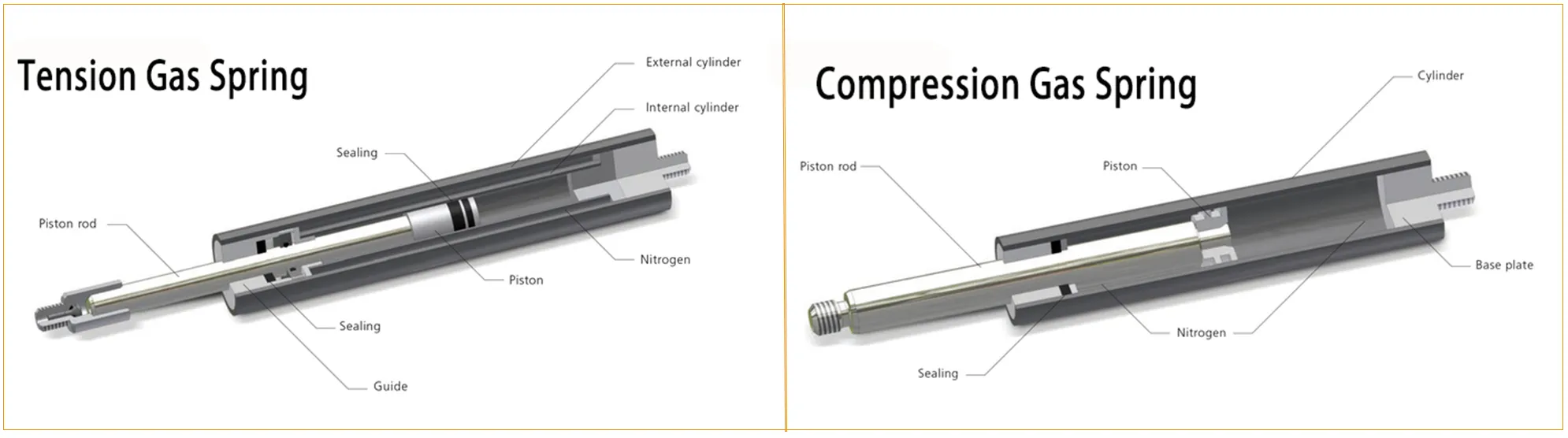
To solve the problem of “softness,” one must first understand the internal mechanics of the tension model. While they share a similar silhouette to standard gas springs, their DNA is diametrically opposed.

FeatureTension Gas Struts (Pulling)Compression Gas Springs (Pushing)
Resting StateFully retracted. Internal pressure constantly pulls the rod inward.Fully extended. Internal pressure constantly pushes the rod outward.
Force DirectionPulling force toward the cylinder body.Pushing force away from the cylinder body.
Space EnvelopeIdeal for compact designs with no external rod clearance required at rest.Requires clearance for rod extension during operation.
Rod ProtectionRod is fully protected inside the cylinder when closed.Rod is exposed and more vulnerable to impact when closed.

Technical Core: How Tension Gas Springs Actually Work

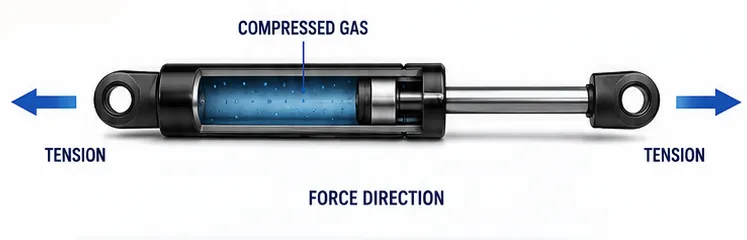
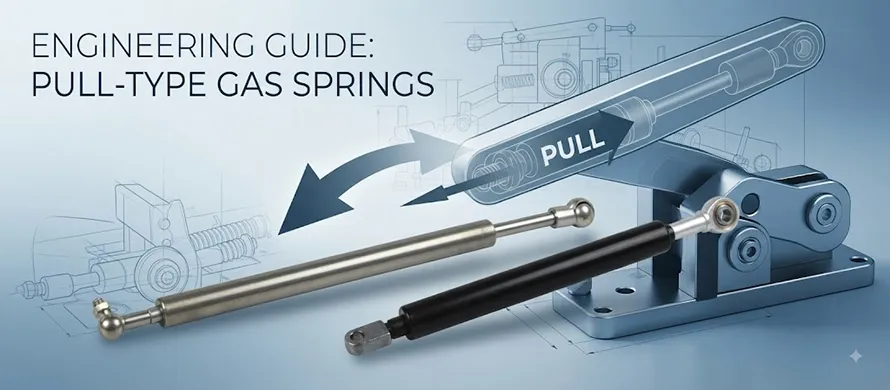
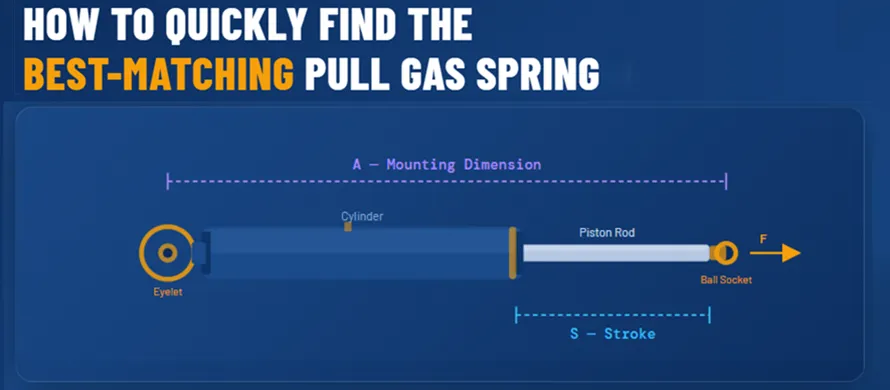
Unlike standard compression springs that push the rod out, a tension gas spring works on a “pull-back” principle. The internal pressure is designed to keep the piston rod retracted when at rest.

The “Friction vs. Force” Battle

The stability of the pull force ($F_1$) depends on the seal’s integrity. Top-tier brands like Hahn Gasfedern and Stabilus succeed because they prioritize:

  • Nitrogen Purity: Using 99.9% pure Nitrogen to prevent internal oxidation.
  • The Double-Lip Seal: Unlike cheap alternatives, a double-lip system prevents “ingestion” of dust when the rod retracts, which is the #1 cause of seal scarring.

Signs Your Tension Gas Spring Is Losing Force

A weakening tension gas spring usually shows several early warning signs before complete failure occurs. Identifying these symptoms early can help prevent equipment damage, unsafe operation, and unexpected downtime. Common symptoms include:

  • Slower extension or retraction speed
  • Reduced pulling force during operation
  • Inconsistent movement or jerking
  • Failure to fully retract
  • Visible oil leakage near the rod seal
  • Increased vibration or noise during cycling
  • Difficulty holding panels, lids, or doors in position

In industrial environments, force loss often develops gradually as internal pressure decreases and seal wear progresses over time. Applications exposed to salt spray, heavy vibration, high cycling frequency, or side loading typically experience faster degradation than standard indoor installations.

Why “Softening” Happens: The Physics of Force Loss

In high-stakes industrial and marine applications, a tension gas spring (often called a pull-type gas strut) is a critical component for safety and controlled motion. However, many engineers face a recurring frustration: springs that “go soft” or fail entirely within months.

The difference between a generic component and an engineering-grade solution like GASTAC lies in three invisible technical areas: Surface Chemistry, Nitrogen Purity, and Kinematic Sealing.

1. The Surface Battle: QPQ Liquid Nitriding vs. Industrial Chrome

Most brands use hard chrome plating for their piston rods. While it looks shiny, it is often the primary point of failure in tension applications.

Technical Comparison Matrix

Technical MetricStandard Chrome PlatingGASTAC QPQ NitridingEngineering Benefit
Surface HardnessHV 600 - 700HV 800 - 1000Superior scratch resistance
Micro-StructureContains micro-cracksNon-porous diffusion layerEliminates potential gas leak paths
Coating IntegrityRisk of peeling or flakingIntegrated with base metalNo debris damage to internal seals
LubricationDry surfaceMicro-microporous oil retentionLower friction and smoother pull action

The GASTAC Advantage: By using QPQ (Quench-Polish-Quench), we don’t just “paint” the rod; we transform the metal’s molecular structure. This ensures the rod remains mirror-smooth even after 50,000+ cycles, protecting the seal from premature wear.

2. Solving the Three “Silent Killers” of Tension Gas Struts

A. Nitrogen Permeation (The Purity Gap)

  • The Problem: Low-cost manufacturers fill cylinders with nitrogen at less than 99% purity. Oxygen and moisture molecules inside the cylinder accelerate gas permeation through the rubber seals.
  • The Result: A steady drop in the initial pull force ($F_1$). If your hatch becomes harder to open over time, the nitrogen has likely leaked out at a molecular level.
  • The Solution: GASTAC uses 99.9% Pure Nitrogen, maintaining consistent force over the product’s entire lifespan.

B. The “Ingestion” Effect

  • The Problem: In a tension model, the piston rod is extended when the application is “open” (e.g., a yacht engine cover). This exposes the rod to salt spray, dust, and grime.
  • The Result: When the spring retracts, a standard single-lip seal “swallows” these contaminants into the cylinder. This causes microscopic-scarring on the seal’s contact surface.
  • The Solution: We implement a Double-Lip Sealing System. The outer lip acts as a high-precision wiper, while the inner lip maintains the high-pressure gas barrier.

C. Lubrication Migration & Dry Friction

  • The Problem: Tension gas springs are often mounted at angles that cause internal oil to migrate away from the main seal.

  • The Result: A dry seal is a failing seal. Without a constant oil film, the friction generates heat that cracks and hardens the rubber.
  • The Solution: GASTAC internal chambers are engineered with Guided Lubrication Channels, ensuring the seal is bathed in synthetic oil regardless of the mounting orientation.

3. Procurement Checklist: Don’t Pay for the Brand, Pay for the Specs

Before finalizing your next PO, ask your current supplier these three “Elimination Questions”:

  • “What is your $F_1$ force tolerance?” (Generic brands offer $pm 10%$; GASTAC maintains a precision of $pm 3%$ to $pm 5%$).
  • “Is the rod surface Chrome or QPQ?” (Always choose QPQ for industrial-grade pull mechanisms).
  • “Does your seal design account for ‘Ingestion’ in dirty environments?” (Insist on a double-lip or specialized wiper system).

How Force Loss Happens Inside a Tension Gas Spring?

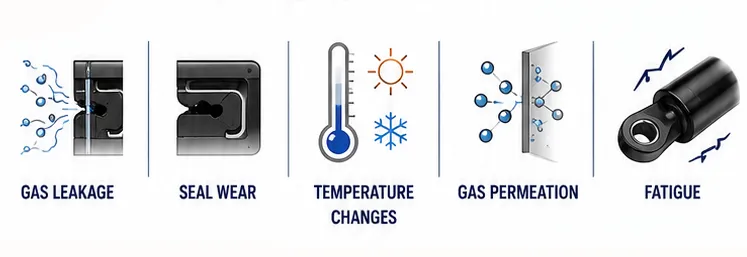
A tension gas spring operates by storing compressed nitrogen gas inside a sealed pressure tube. As the rod moves during operation, internal gas pressure generates the pulling force required for controlled motion. Over time, several internal changes gradually reduce performance:

  • Nitrogen molecules slowly permeate through aging seals
  • Internal lubrication begins to break down
  • Friction increases between moving components
  • Rod surface wear damages sealing integrity
  • Pressure balance becomes unstable

Once internal pressure drops below the designed operating range, the gas spring can no longer provide consistent pulling force. This process usually develops gradually rather than suddenly, especially in high-cycle industrial applications.

How Much Force Loss Is Normal?

Some force reduction over time is considered normal for all gas springs due to gradual seal wear and natural gas permeation. However, excessive force loss usually indicates abnormal operating conditions or internal damage.

Operating ConditionTypical Force LossEngineering Note
New gas spring±5% force toleranceInitial factory calibration range
Normal service life5–10% gradual reductionExpected performance decay under standard use
High-cycle industrial use10–20% faster degradation possibleIncreased seal wear due to frequent cycling
Side-loaded applicationsAccelerated force lossRod and seal misalignment increases friction
Marine environmentsCorrosion-related rapid degradationSalt exposure accelerates seal and coating wear

Proper installation, correct force selection, and regular inspection can significantly extend operational life.

Tension Gas Springs Technical Reference & Range

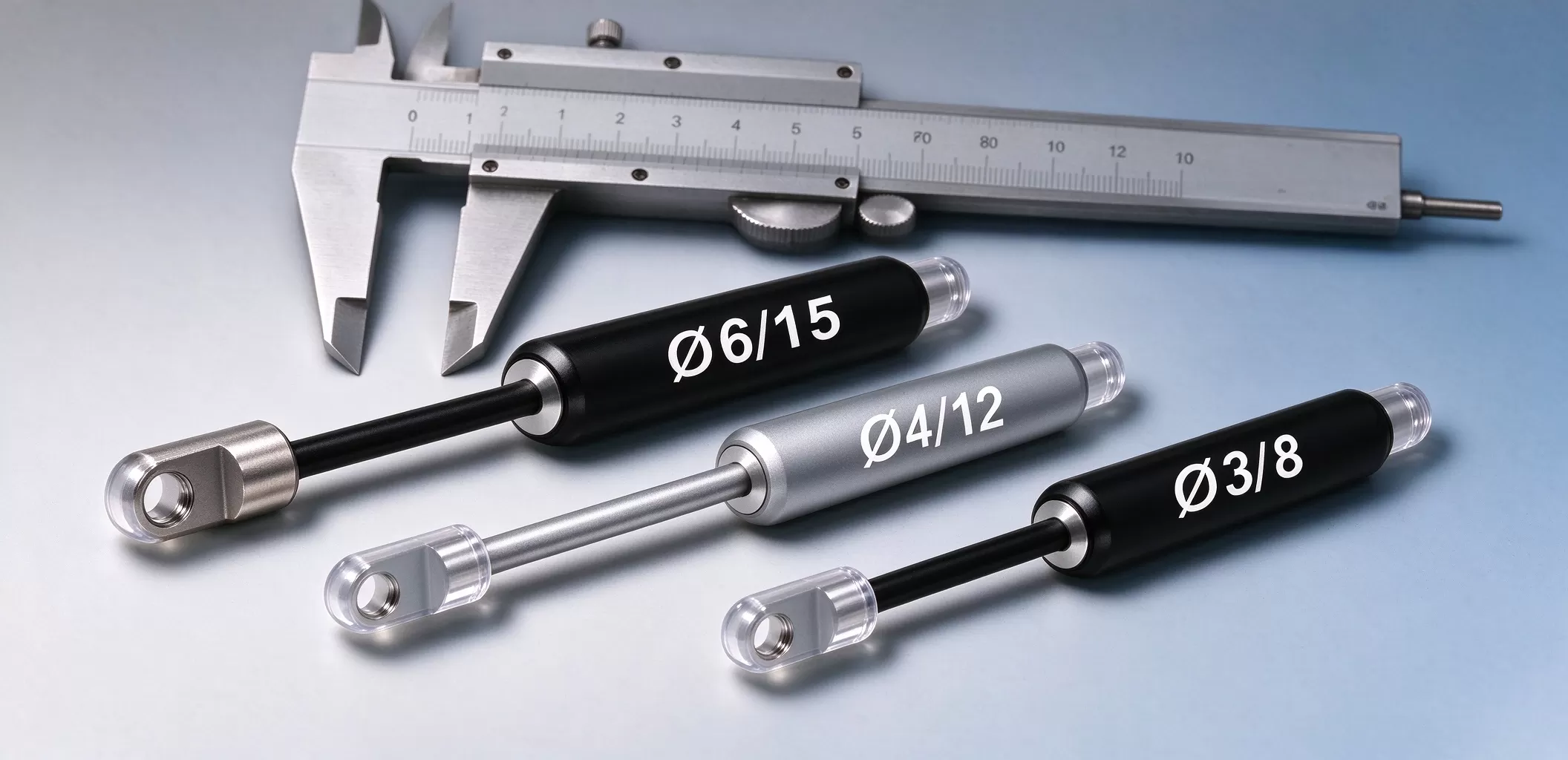
To assist engineers in the selection process, the following tables represent the core parameters of OEM-grade tension gas struts.

SizeStroke RangeForce RangeK-FactorExtended LengthMaterials
6/1530 – 300 mm100–600 N1.552 × Stroke + 85 mmSteel
8/1830 – 400 mm200–1000 N1.602 × Stroke + 85 mmSteel
10/2230 – 500 mm300–1112 N1.602 × Stroke + 100 mmSteel
14/2850 – 500 mm500–3500 N1.702 × Stroke + 100 mmSteel

Best-Selling Tension Gas Springs Size Chart

IDRod ØBody ØStrokeExtended LengthForce Range (lbs)Thread Size
GST1022022510 mm (0.39 in)22 mm (0.87 in)57.15 mm (2.25 in)155.96 mm (6.14 in)25–300M8x1.25
GST1022030010 mm (0.39 in)22 mm (0.87 in)76.20 mm (3 in)219.46 mm (8.64 in)25–300M8x1.25
GST1022035010 mm (0.39 in)22 mm (0.87 in)88.90 mm (3.50 in)270.26 mm (10.64 in)25–300M8x1.25
GST1022055010 mm (0.39 in)22 mm (0.87 in)139.70 mm (5.50 in)346.46 mm (13.64 in)25–300M8x1.25
GST1022060010 mm (0.39 in)22 mm (0.87 in)152.40 mm (6 in)397.26 mm (15.64 in)25–300M8x1.25
GST1022080010 mm (0.39 in)22 mm (0.87 in)203.20 mm (8 in)473.46 mm (18.64 in)25–300M8x1.25
GST1022100010 mm (0.39 in)22 mm (0.87 in)254.00 mm (10 in)568.96 mm (22.40 in)25–300M8x1.25
GST1022125010 mm (0.39 in)22 mm (0.87 in)317.50 mm (12.50 in)711.20 mm (28 in)25–300M8x1.25

Material Mastery: Why QPQ Carbon Steel Defeats All

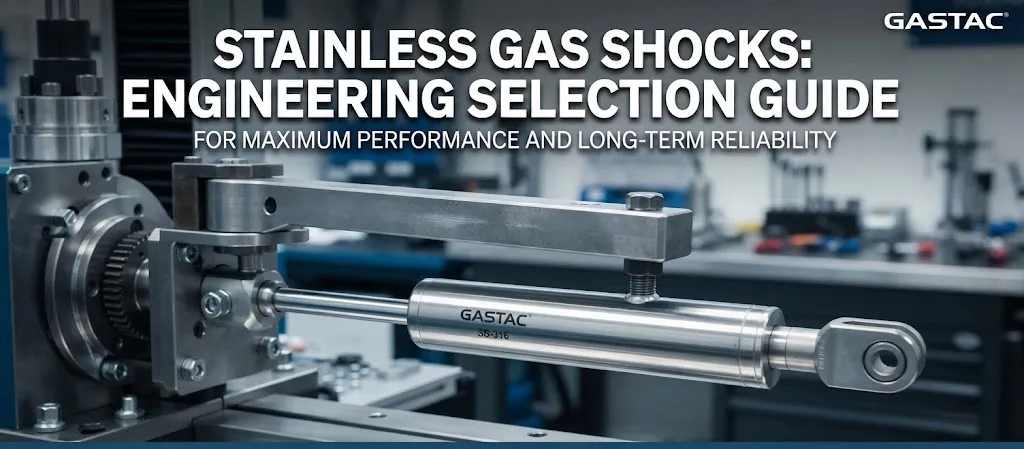
Forget stainless steel for high-frequency industrial applications. For maximum longevity and seal life, QPQ (Quench-Polish-Quench) Liquid Nitriding on high-grade Carbon Steel is the undisputed champion.

  • Surface Hardness: QPQ reaches a hardness of $HV_ ge 800$. It is significantly tougher than standard steel, drastically reducing the friction-induced wear that leads to gas leaks.
  • Self-Lubricating Properties: The nitrided layer is microporous, meaning it “holds” oil molecules. This ensures the seal never runs dry, even after long periods of inactivity.
  • Corrosion Resistance: Despite not being stainless, QPQ-treated carbon steel easily passes 144h to 240h salt spray tests (ISO 9227), providing the durability needed for heavy-duty OEM environments without the structural softness of stainless alloys.

Comparing Global Tension Gas Spring Suppliers

When evaluating brands like Bansbach, ACE Controls, or IGS, don’t just look at the price. Look at the Total Cost of Ownership (TCO) using these benchmarks:

  • Force Progression ($P_2/P_1$): Ask for the ratio. A premium Tension Gas Spring should stay between 1.2 and 1.5. Anything higher indicates excessive internal stress.
  • Kinematic Support: Does the supplier offer mounting simulation? A part is only as good as the geometry it operates in.
  • Digital Integration: Top suppliers provide instant . STEP or .DWG downloads. If you have to wait 3 days for a drawing, you’ve already lost money.
  • DG Compliance: Are they certified for the global shipping of high-pressure nitrogen (UN3163)? This prevents logistical nightmares at the border.

How GASTAC Engineering Mitigates Force Loss

When evaluating brands like Bansbach, ACE Controls, or IGS, don’t just look at the price. Look at the Total Cost of Ownership (TCO) using these benchmarks:

  • Force Progression ($P_2/P_1$): Ask for the ratio. A premium Tension Gas Spring should stay between 1.2 and 1.5. Anything higher indicates excessive internal stress.
  • Kinematic Support: Does the supplier offer mounting simulation? A part is only as good as the geometry it operates in.
  • Digital Integration: Top suppliers provide instant . STEP or .DWG downloads. If you have to wait 3 days for a drawing, you’ve already lost money.
  • DG Compliance: Are they certified for the global shipping of high-pressure nitrogen (UN3163)? This prevents logistical nightmares at the border.

How to Extend Tension Gas Spring Service Life?

Several preventive maintenance practices can significantly improve tension gas spring lifespan and performance stability. Recommended practices include:

  • Avoid side loading during installation
  • Keep the piston rod clean and free from contamination
  • Prevent scratches or impact damage on the rod surface
  • Use stainless steel gas springs in marine environments
  • Select proper force ratings for the application
  • Avoid over-compression or over-extension
  • Inspect mounting brackets regularly for misalignment
  • Replace worn gas springs before complete failure occurs

In harsh industrial environments, regular inspection intervals are critical for preventing unexpected equipment downtime.

Technical Comparison: GASTAC vs. Standard Tension Gas Springs

Choosing the right manufacturer is the difference between a 1-year replacement cycle and a 5-year maintenance-free operation.

FeatureStandard Traction SpringsGASTAC Professional Series
Annual Force Loss Rate8% - 12%< 2.5% (Certified Lab Data)
Cycle Life Expectancy10,000 - 20,000 cycles50,000+ cycles (Heavy-Duty)
Seal MaterialStandard industrial rubberHigh-resilience FKM / automotive grade
Surface ProtectionBasic electroplatingAdvanced QPQ or 1000h salt spray coating
Operating Temperature Range-20°C to +60°C-40°C to +120°C (customized)

Does your Application Require Long-term Tension Stability?

Force loss is predictable, but it shouldn’t be a failure point. GASTAC’s engineers provide free Force Compensation Calculations to help you specify the correct initial pressure for your equipment’s entire lifecycle.

张航

Stay in the loop

Subscribe to our free newsletter.

Leave A Comment