








Table of contents
Share Post

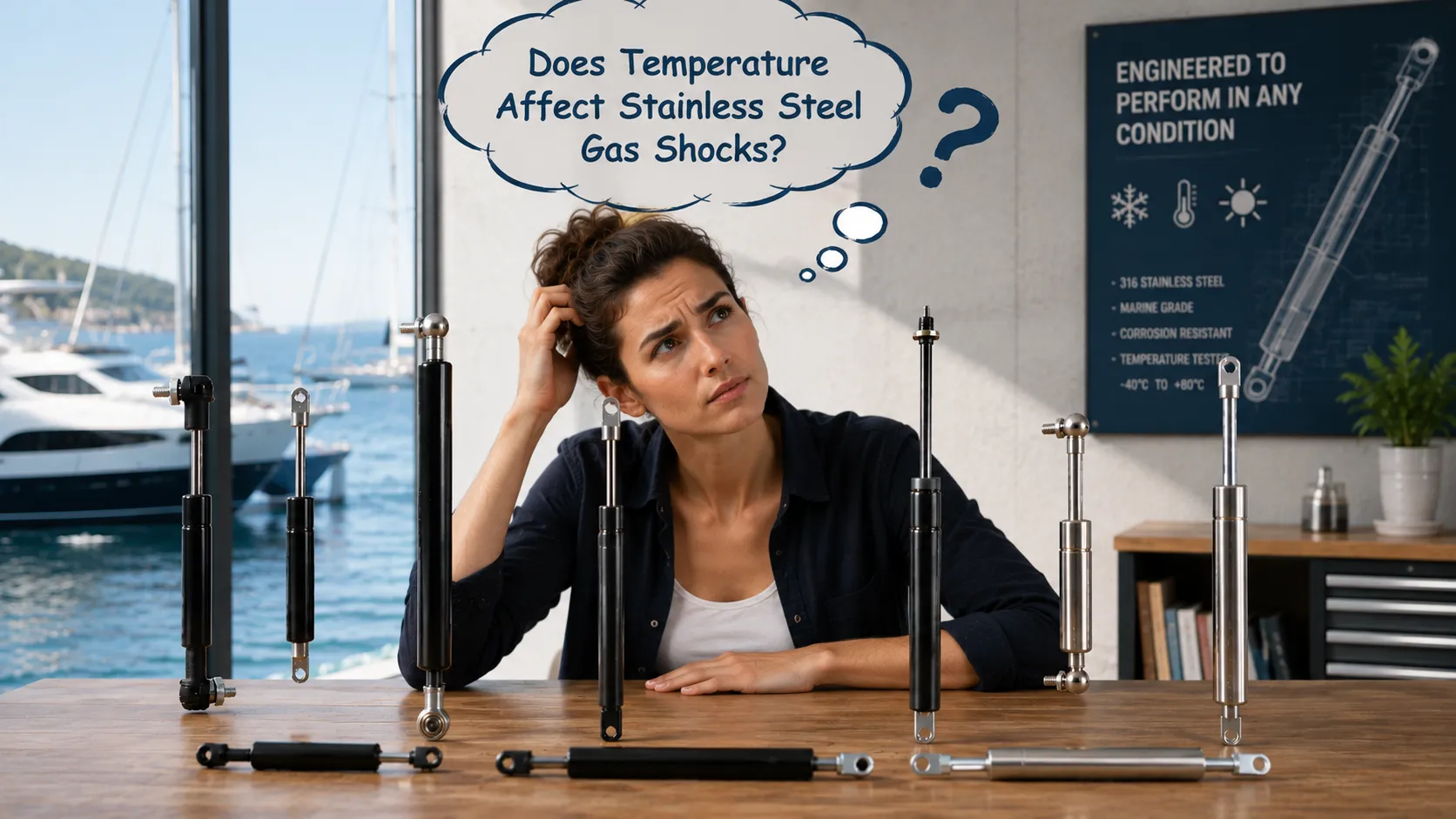
Engineers often specify stainless steel gas shocks for harsh environments to fight corrosion. But while stainless steel stops rust, it cannot stop physics.

Temperature fluctuations drastically alter internal pressure, fluid dynamics, and seal integrity. Here is the quick technical breakdown of exactly how thermal variance changes gas shock performance.

The Thermodynamics: Why Force Drops in the Cold

A gas shock is fundamentally a constant-volume pressure vessel filled with nitrogen (N2). When temperature changes, internal pressure follows the Ideal Gas Law (PV = nRT). Because the volume (V) is fixed, pressure (P) drops linearly as temperature (T) falls.

  • The 3.5% Rule: As an industry benchmark, for every 10°C (18°F) drop in temperature, a gas shock loses roughly 3.5% of its output force.
  • The Math: A shock rated for 1,000N at 20℃ will inherently drop to around 860N if operated at -20℃.

The Metallurgy: Why Stainless Steel Matters in Extreme Cold

Stainless steel does not fix the internal pressure drop mentioned above. Instead, its advantage is purely structural.

  • Carbon Steel Failure: Standard carbon steel has a Body-Centered Cubic (BCC) crystal structure. At sub-zero temperatures, it hits a Ductile-to-Brittle Transition Temperature (DBTT), becoming brittle and prone to cracking under high internal pressures.
  • Stainless Steel Safety: Austenitic stainless steel (like 304 or 316) has a Face-Centered Cubic (FCC) lattice. It never undergoes a brittle transition, maintaining high structural toughness even down to cryogenic levels (below -150℃).
  • Engineering Takeaway: Stainless steel ensures the high-pressure cylinder wall won’t rupture or fail structurally in freezing environments.

While overcoming low-temperature brittleness is vital, it is just one of many variables. To ensure you balance force margins, stroke lengths, and environmental demands, see our complete guide on factors to consider when selecting stainless steel gas shocks.

The Bottleneck: Oil Viscosity & Seal Micro-Leakage

The biggest threat to a gas shock’s life isn’t the metal or the gas—it’s the internal fluid and rubber seals.

  • Thicker Damping Oil: Extreme cold spikes the kinetic viscosity of the internal hydraulic damping oil. The oil thickens like honey, leading to sluggish extension speeds.
  • Seal Hardening: Standard Nitrile (NBR) rubber seals lose elasticity near -20℃. Once the seal hardens, it cannot stay flush against the moving piston rod, causing micro-leakage of nitrogen and permanent force loss.

Engineering Spec Sheet: Thermal Mitigation

When designing for extreme thermal ranges, use this quick material selector guide:

Component / ParameterRecommended SpecificationTemperature Range
Standard SealNBR (Nitrile)−30°C to +100°C
High-Temp SealViton (FKM)−20°C to +200°C
Cryogenic Seal Low-Temp Silicone / Polyurethane−50°C to +80°C
Design Force Margin Add 10% to 15% force redundancy For sustained sub-zero use
Rod Surface Finish Ra ≤ 0.15μm (Ultra-polished) Prevents tearing stiffened seals

张航

Stay in the loop

Subscribe to our free newsletter.

Leave A Comment