
















How to Choose Locking Gas Shocks for Dialysis Chairs

Dialysis chairs are critical medical equipment designed for long-duration patient treatment, where comfort, safety, and precise positioning are non-negotiable. Behind every smooth reclining or height adjustment is a motion control system that must perform reliably under repeated use and variable patient loads. In this context, locking gas shocks (locking gas springs or locking gas struts) are often selected as part of the chair’s adjustment mechanism. However, in real engineering practice, the selection process is not about choosing a catalog product—it is about translating the dialysis chair’s mechanical requirements into a correctly defined gas spring specification.

This article explains how to properly select and define locking gas shocks based on dialysis chair application data, and how gas spring manufacturers like GASTAC approach engineering-based customization.

Selecting Locking Gas Shocks Based on Application

A common misunderstanding is to start the selection process by searching for “locking gas shocks for dialysis chairs.” In reality, medical equipment manufacturers do not think in terms of gas spring products—they think in terms of:

  • Seat/backrest/leg rest motion design
  • Patient load requirements
  • Safety and stability during adjustment
  • Structural constraints of the chair frame

The gas spring is only one component within a broader motion system. Therefore, the correct starting point is:

“What movement must the dialysis chair perform, and under what load conditions?”

Only after this is defined can the locking gas shock be engineered.

Understand the Functional Requirements of Dialysis Chairs

Dialysis chairs typically require multi-position adjustment systems, including:

  • Backrest reclining adjustment
  • Leg rest elevation or extension
  • Height or tilt mechanisms (in some models)

From a locking gas spring perspective, the key functional requirements are:

  • Stable Position Holding: The chair must remain stable in any selected position without drift or gradual lowering, even under long treatment sessions.
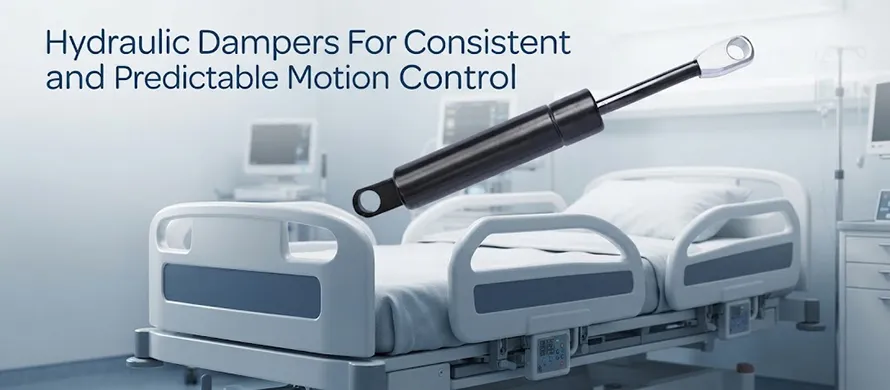
  • Smooth and Controlled Adjustment: Medical staff must be able to adjust the chair with minimal effort and without sudden movement or rebound.
  • High Safety Margin: Even under maximum patient load, the system must not fail or unexpectedly release.
  • Long Service Life: Dialysis chairs operate in high-frequency clinical environments, requiring long cycle life and consistent performance over time.

Key Engineering Inputs Required for Selecting Locking Gas Springs

Unlike general industrial applications, dialysis chair lcoking gas spring selection requires precise mechanical data. The following parameters are essential:

1. Load Conditions

  • Maximum patient weight
  • Distribution of load (backrest vs seat vs leg support)
  • Dynamic vs static load scenarios

This is the foundation for locking gas shock force calculation.

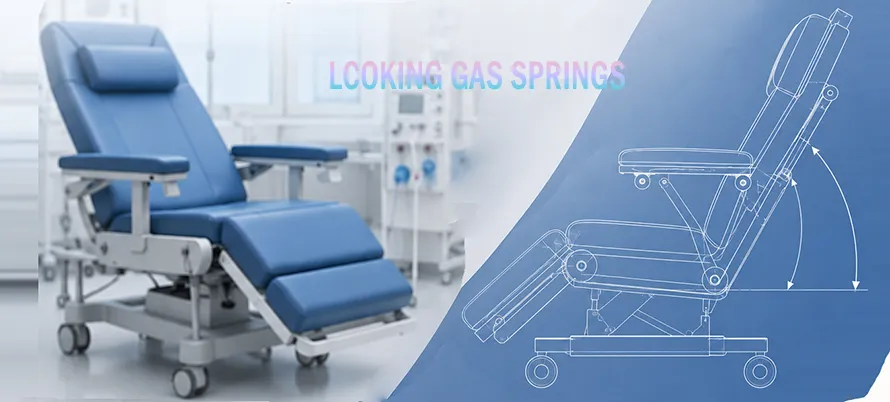
2. Installation Geometry

Gas spring force is not an isolated parameter—it depends heavily on geometry:

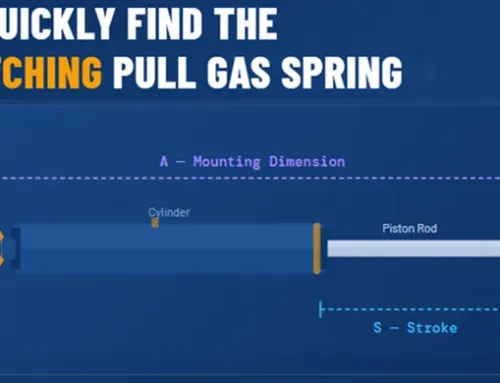
  • Mounting distance (center-to-center)
  • Lever arm length
  • Pivot positions
  • Installation angle range

Small changes in geometry can significantly affect required force.

3. Motion Requirements

Gas spring force is not an isolated parameter—it depends heavily on geometry:

  • Stroke length (mm)
  • Rotation angle range (e.g., 0–60°, 0–75°)
  • Speed of adjustment (manual vs assisted movement)

These define how the gas spring behaves during operation.

4. Locking Behavior Definition

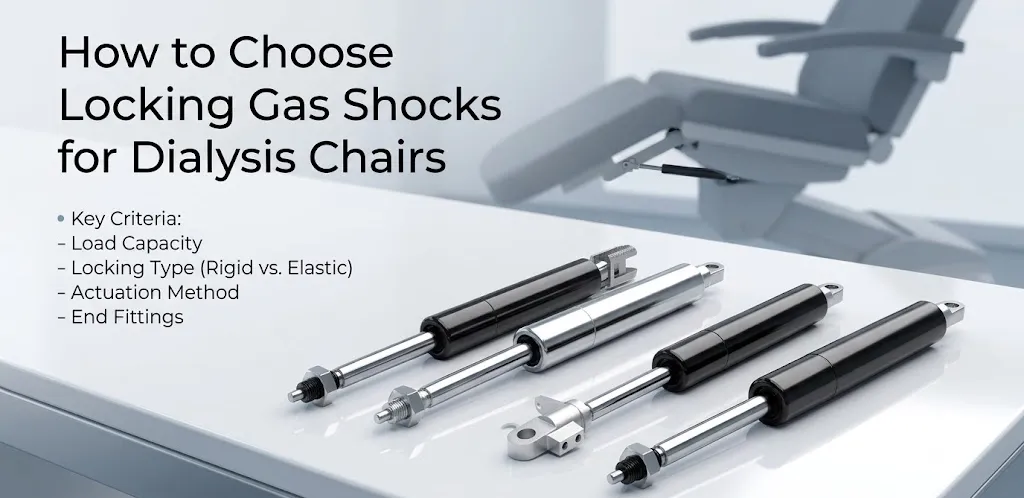
The term “locking gas shock” can generally be classified into two functional behaviors in medical chair applications:

  • Rigid (Hard) Locking Systems – provide near-fixed position holding with minimal or no movement under load, typically used in higher safety-demanding or load-critical mechanisms
  • Elastic (Soft) Locking Systems – allow slight controlled micro-movement while maintaining position stability through internal damping or friction-based resistance, commonly used in medical seating applications for smoother adjustment

Clarifying whether a rigid locking or elastic locking behavior is required is critical before selecting the correct gas spring solution, as it directly affects safety performance, adjustment feel, and long-term stability.

4. Locking Behavior Definition

The term “locking gas shock” can generally be classified into two functional behaviors in medical chair applications:

  • Rigid (Hard) Locking Systems – provide near-fixed position holding with minimal or no movement under load, typically used in higher safety-demanding or load-critical mechanisms
  • Elastic (Soft) Locking Systems – allow slight controlled micro-movement while maintaining position stability through internal damping or friction-based resistance, commonly used in medical seating applications for smoother adjustment

Clarifying whether a rigid locking or elastic locking behavior is required is critical before selecting the correct gas spring solution, as it directly affects safety performance, adjustment feel, and long-term stability.

5. Environmental Conditions

The term “locking gas shock” can generally be classified into two functional behaviors in medical chair applications:

  • Frequent cleaning with disinfectants
  • Humidity exposure
  • Repeatedly adjust and restore the locked position.

The material, surface treatment process, and cycle life of the locking gas shock must be selected accordingly.

How to Determine the Force of a Locking Gas Spring

Locking as spring force is not a fixed value—it is derived from torque balance in the chair mechanism. In simplified form:

  • The patient load generates a moment (torque) around the pivot
  • The gas spring must generate an opposing moment
  • Geometry determines how efficiently force is applied

This is why two dialysis chairs with the same weight capacity may require completely different gas spring forces.

Common Mistakes When Selecting Locking Gas Springs

  • Selecting Based Only on Load: Weight alone is not sufficient. Geometry often has greater influence than load.
  • Assuming “Locking” Means Rigid Fixation: Most dialysis chair systems use friction or controlled damping, not absolute rigid locking.
  • Ignoring Installation Angle: Incorrect geometry misaligns force, causing either insufficient locking or stiff adjustment.
  • Using Standard Off-the-Shelf Specifications: Dialysis chairs almost always require customization.

Recommended Selection Process for Locking Gas Springs

The professional selection process for locking gas springs typically involves the following steps:

  • Application Review: Understand chair structure, motion type, and functional zones.
  • Force and Torque Calculation: Based on load and geometry, determine required force range.
  • Motion Simulation: Validate stroke, angle, and force curve behavior.
  • Prototype Matching: Provide 2–3 optimized configurations for testing.
  • Final Adjustment: Fine-tune force, damping, or end fittings based on real chair performance.

What Gas Spring Manufacturers Like GASTAC Provide

At GASTAC, we do not treat locking gas springs as standard catalog components. Instead, we design them as part of a motion system tailored to medical applications. GASTAC engineering approach includes:

  • Force calculation based on chair geometry
  • Custom stroke and end fitting design
  • Controlled damping or friction locking behavior
  • Corrosion-resistant surface treatment options
  • Long-cycle life validation for medical usage

The goal is not just to supply a gas spring, but to ensure:

“The dialysis chair moves safely, smoothly, and consistently throughout its entire service life.”

Request a Quote

Need help selecting locking gas shocks for a dialysis chair? Instead of choosing a gas spring from a catalog, start with your chair application data. Send us:

  • Chair drawings or mechanism layout

  • Maximum patient load capacity

  • Adjustment function (backrest, leg rest, or seat section)

  • Installation dimensions and available space

  • Required adjustment angle or travel range

  • Your Content Goes Here

Based on your application, GASTAC engineers will:

  • Calculate the required gas spring force

  • Recommend the optimal locking behavior

  • Define stroke, extension length, and mounting fittings

  • Optimize safety, stability, and user operation

  • Provide a customized quotation and OEM solution

Contact GASTAC to get a dialysis chair lcoking gas spring solution engineered specifically for your design.

Stay in the loop

Subscribe to our free newsletter.