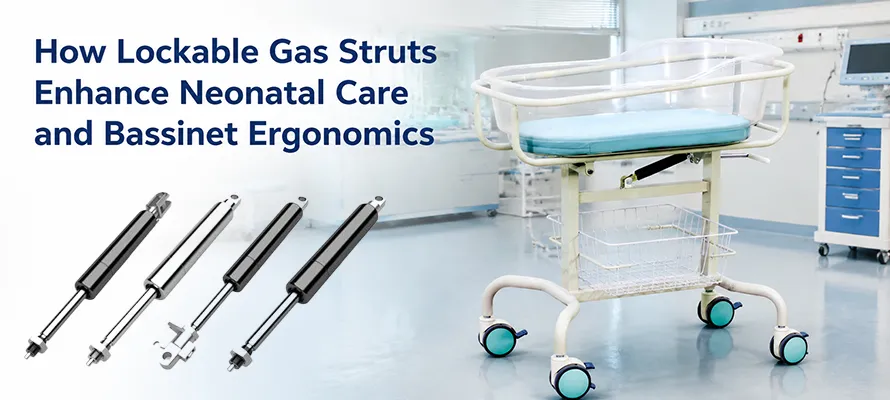





















In modern neonatal and pediatric care environments, every movement matters. Hospital equipment used for newborns—especially bassinets—must combine smooth mobility with absolute stability. Even minor unintended motion can create safety risks or disrupt critical care procedures.
This is where lockable gas struts play a crucial role in transforming how hospital newborn bassinets are designed and operated. At GASTAC, we design lockable gas spring solutions that enable precise positioning, secure locking, and controlled movement for medical applications where safety is non-negotiable.
Why Hospital Newborn Bassinets Require Advanced Motion Control
Hospital newborn bassinets are not static devices. They are frequently adjusted and moved for:
- Neonatal examination and treatment
- Height adjustment for caregiver ergonomics
- Patient transfer between departments
- Emergency response positioning
- Parent-infant interaction support
In all these scenarios, the bassinet must remain both easy to adjust and completely stable once positioned. Traditional mechanical supports or non-locking gas springs often fail to meet this dual requirement.
Lockable Gas Struts Key Challenges Regarding Motion and Stability
Medical equipment designers face a constant engineering contradiction:
“How do you allow smooth, effortless movement while ensuring absolute positional stability at every stage of use?”
Without a reliable lockable gas strut mechanism, bassinets may experience:
- Slow unintended drifting under load
- Instability during care procedures
- Increased operator effort to maintain position
- Reduced confidence in equipment safety
This is particularly critical in NICU environments, where patients are extremely vulnerable and precision is essential.
How Lockable Gas Struts Solve This Problem
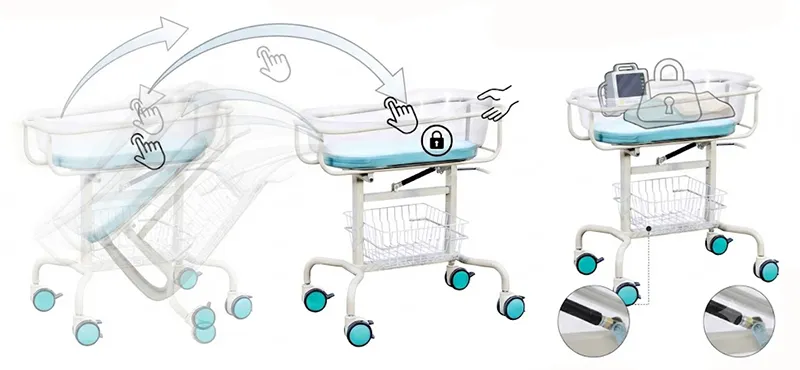
Lockable gas struts combine controlled motion with position-holding capability. Unlike standard gas springs, they allow the user to:
- Move equipment smoothly with minimal force
- Stop and hold at any position along the stroke
- Maintain stable locking even under variable load conditions
This transforms a newborn bassinet from a simple support structure into a controlled motion system.

Key Benefits of Lockable Gas Struts in Hospital Bassinet Newborn
In neonatal and pediatric care environments, hospital bassinets must support frequent adjustments while maintaining absolute stability. Lockable gas struts play a critical role in ensuring that these movements remain controlled, precise, and safe throughout daily clinical use.
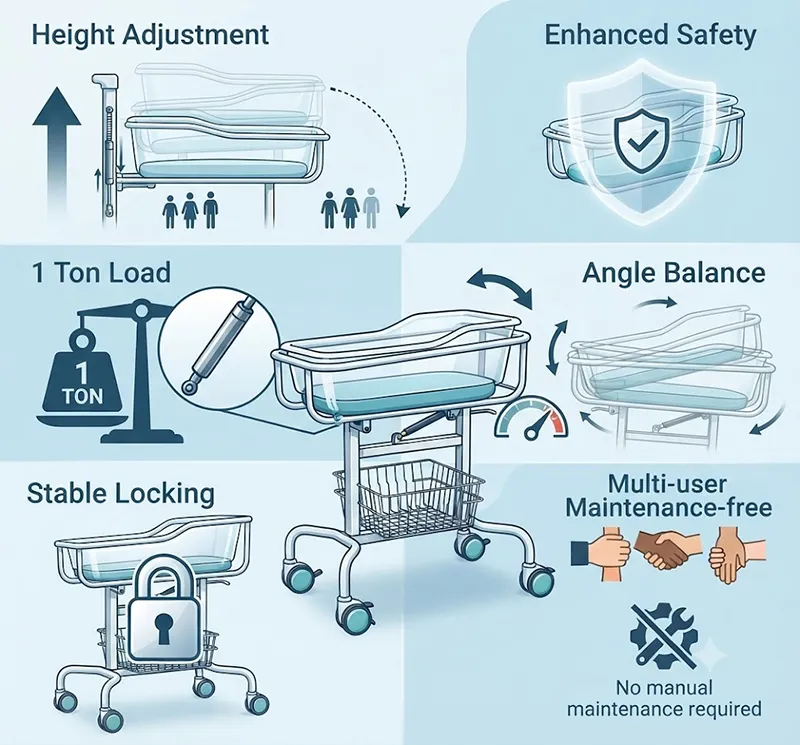
- Allows for rapid adjustment of support height to accommodate different users.
- Ensures a stable, locked position while caring for the infant.
- Lockable gas springs withstand static loads of up to 1 ton.
- Supports various mounting positions and angles to ensure balance.
- Enhances safety and prevents accidents during caregiving.
- Supports height adjustment by multiple users without the need for manual maintenance.

Process to Choose the Appropriate Lockable Gas Struts
Selecting the right lockable gas struts for hospital newborn bassinets is not only a component selection task—it is an engineering decision that directly affects patient safety, caregiver efficiency, and long-term equipment reliability. A structured selection process ensures that the final system delivers stable positioning, smooth motion, and dependable locking performance under real clinical conditions.
1. Define the Application Movement Requirements
The first step is to clearly understand how the bassinet will be used in daily hospital workflows. Different departments such as NICU, maternity wards, or transport units may require different motion behaviors. Key questions include:
- Does the bassinet require height adjustment, tilt adjustment, or both?
- How frequently will adjustments be made per shift?
- Is the movement primarily for positioning, transport, or patient care access?
A clear application profile ensures the lockable gas strut is matched to real operational needs, not just static specifications.
2. Determine Load and Force Requirements
Accurate load calculation is critical for stable performance. The gas strut must support the combined weight of the bassinet structure, mattress, and newborn patient while maintaining smooth controllability. Important considerations:
- Total operating load range (including accessories)
- Weight distribution across the mechanism
- Required support force for neutral balance
Incorrect force selection may result in drifting, difficult adjustment, or insufficient stability during locking.
3. Evaluate Required Locking Performance
In hospital bassinets, locking performance is a safety-critical factor. The selected lockable gas strut must ensure reliable position holding under dynamic conditions. Evaluate:
- Holding stability under variable load
- Resistance to slow compression or extension drift
- Consistency of locking behavior across full stroke range
- Safety margin for unexpected external forces
This step ensures the system remains stable even during high-frequency clinical use.
4. Define Stroke Length and Installation Geometry
Mechanical integration plays a major role in performance. Stroke length and mounting geometry must align with the bassinet’s design structure. Key design checks:
- Required range of motion (minimum to maximum position)
- Available installation space inside the frame
- Mounting angle and pivot constraints
- Interference with surrounding components
Proper geometry ensures smooth movement and reduces mechanical stress on the system.
5. Consider Operational Environment Requirements
Hospital environments have strict requirements for cleanliness, durability, and noise control. The selected gas strut must perform reliably under these conditions. Factors include:
- Corrosion resistance for frequent cleaning and disinfection
- Low-noise operation for neonatal environments
- Long cycle life under repeated use
- Stable performance under temperature and humidity variations
These conditions are especially important in NICU and pediatric care areas.
6. Validate Long-Term Cycle Performance
Hospital bassinets are used continuously, often undergoing thousands of adjustment cycles. Long-term durability must be verified during selection. Key evaluation points:
- Cycle fatigue resistance
- Consistency of force over time
- Locking stability after repeated use
- Maintenance requirements over product lifecycle
A high-quality lockable gas strut should maintain predictable performance even after extensive usage.
6. Validate Long-Term Cycle Performance
Hospital bassinets are used continuously, often undergoing thousands of adjustment cycles. Long-term durability must be verified during selection. Key evaluation points:
- Cycle fatigue resistance
- Consistency of force over time
- Locking stability after repeated use
- Maintenance requirements over product lifecycle
A high-quality lockable gas strut should maintain predictable performance even after extensive usage.
7. Work with a Medical-Grade Engineering Supplier
Finally, selection should be confirmed in collaboration with an experienced gas spring manufacturer. Application-specific tuning is often required to achieve optimal performance in medical equipment. At this stage, engineering support typically includes:
- Force calibration based on real equipment prototypes
- Mounting optimization recommendations
- Prototype testing and validation
- Safety margin verification for medical use cases
Working with an experienced supplier such as GASTAC ensures the selected solution meets both performance and safety expectations in clinical environments.
How to Choose High Quality Lockable Gas Struts
In hospital newborn bassinets and other medical equipment applications, choosing high quality lockable gas struts is essential for ensuring safe positioning, smooth movement, and long-term reliability. Because these systems directly affect patient safety and caregiver operation efficiency, selection should go beyond basic specifications and focus on performance consistency under real clinical conditions.
- Use high-strength carbon steel and precision seamless steel tubing for cylinder construction
- High-quality piston rod with hard chrome plating for wear and corrosion resistance
- Stable locking mechanism with zero-position drift under static load
- Cycle life tested up to 25000 cycles or more under full load conditions
- Compatibility with Bowden cable release systems and end fitting assemblies
- Verified performance under medical safety and rehabilitation equipment standards
How to Choose a Lockable Gas Strut Manufacturer
Selecting the right lockable gas strut manufacturer is a critical decision for medical equipment designers, especially in applications such as hospital newborn bassinets, where motion control directly impacts patient safety, caregiver efficiency, and long-term reliability. Beyond product specifications, the manufacturer’s engineering capability, quality systems, and application experience determine the real-world performance of the final system.
- With a proven track record of serving over 100 medical industry clients, we have established long-term partnerships with leading brands.
- Factory scale with over 3,000 m² production facility and 100+ employees, including engineering, production, and quality control teams
- Compliance with international quality and safety standards (e.g., ISO certification)
- Production capacity of 5,000 locking gas springs every two weeks.
- Strict tolerance control for consistent force output across production batches (Error within 0.2%)
- Verified cycle life testing and durability performance reports
- Reliable after-sales service and technical support for long-term cooperation
Stay in the loop