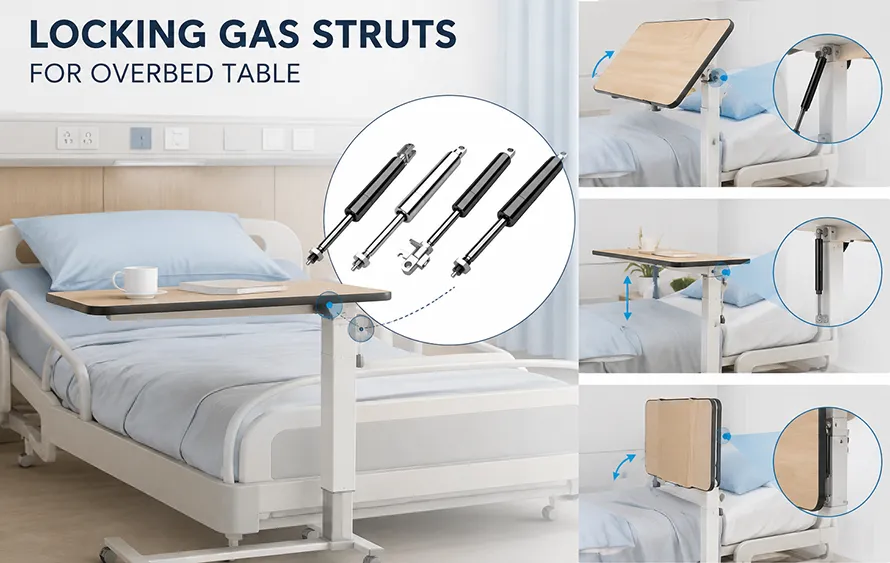















For medical furniture OEMs and healthcare facility procurement teams, the overbed table is a critical touchpoint for patient autonomy and comfort. Whether a patient is dining, using a tablet, or receiving bedside medication, this cantilevered platform must glide upward seamlessly and lock securely in place.
However, engineering an overbed table involves a delicate mechanical balancing act: the table must remain incredibly easy to elevate with one hand, yet it must never slide down unexpectedly under the weight of books, laptops, or leaned-on forearms.
Selecting the correct locking gas spring—specifically optimized for single-column medical lifts—is what separates a flimsy, frustrating bedside table from a premium, smooth-gliding, institutional-grade product.
Overbed Tables Are Not “Medical Machines” — They Are Daily Use
The biggest mistake in many designs is treating overbed tables like complex medical devices. In reality, they behave more like adjustable household furniture used in a very sensitive environment.
A patient or elderly user typically interacts with the table in very simple ways:
- Sliding the table closer or away from the bed
- Raising it slightly to match sitting posture
- Tilting the surface for reading or writing
- Adjusting height while lying down
- Stabilizing food, devices, or medical items on the surface
All of these actions must feel effortless. If adjustment is difficult, slow, or unstable, the user experience immediately becomes frustrating or even unsafe.
Why Locking Gas Springs Fit Overbed Table Behavior Perfectly
A locking gas spring is not just about lifting assistance. In overbed tables, its real value is control with ease. The user does not think in technical terms like “force” or “stroke length.” They think:
- “I want it higher.”
- “I want it flat.”
- “I want it to stay here.”
Locking gas springs translate these simple intentions into smooth mechanical movement. When activated, the table moves easily. When released, it stays exactly where the user wants—without slipping or drifting. That experience is what makes the difference between a basic table and a premium overbed system.
Real User Experiences with Locking Gas Springs for Overbed Tables
To understand why locking gas springs matter, we need to look at real usage scenarios.
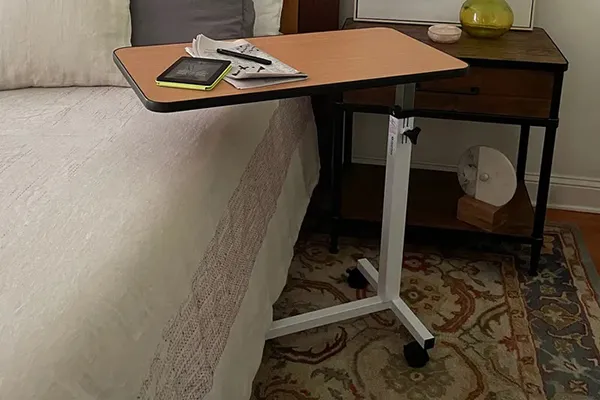
Eating in Bed
One of the most common uses of overbed tables is eating meals. In this case, stability is everything:
- The table must not shake
- The height must match the patient’s posture
- The surface must stay flat and secure
A locking gas spring ensures the table does not slowly drop or tilt under load, which is critical when carrying food or drinks.
Reading or Using a Tablet
Patients often spend long periods reading or watching videos. Here, comfort depends on angle adjustment:
- Slight tilt reduces neck strain
- Stable positioning prevents screen movement
- Smooth adjustment avoids disturbing the user
Without a locking system, the table either feels too rigid or too unstable. Gas springs solve this balance problem.
Light Work or Communication
In rehabilitation centers or home care, patients may:
- Use laptops
- Write documents
- Fill in forms
- Communicate with caregivers
This requires a stable horizontal surface that does not shift under hand pressure. Locking gas springs keep the table locked firmly, even when weight is unevenly distributed.
Why Traditional Adjustment Systems Fail in Overbed Tables
Before gas spring systems became common, overbed tables relied on:
- Manual knobs
- Friction joints
- Sliding rails with fixed positions
These systems create several real problems:
- Users need both hands to adjust
- Settings loosen over time
- Sudden drops when not properly tightened
- Limited positioning flexibility
In a hospital bed environment, these problems become very noticeable because users often have limited strength or mobility. Locking gas springs remove this friction-based experience entirely.
How Locking Gas Springs Improve Table Movement
The key advantage is how naturally the table responds. A well-designed system allows:
- Light push → movement begins
- Controlled resistance → smooth adjustment
- Release → immediate locking
There is no need for tightening, twisting, or mechanical locking steps. This is especially important for:
- Elderly users
- Post-surgery patients
- Home care environments without medical staff support
Design Role in Overbed Table Structures
In real overbed table designs, locking gas springs are not visible as “components.” They are integrated into movement systems such as:
- Height adjustment columns
- Side arm support structures
- Tilting tabletop hinges
Their job is not to be seen—it is to make the table feel effortless. Good design hides complexity while delivering smooth motion.
What Matters Most in Gas Spring Selection for Overbed Tables
For this application, engineers do not only focus on force or size. What matters more is the user feel:
- How easy it is to start movement
- Whether the table stays stable under uneven load
- Whether adjustment feels smooth or mechanical
- Whether it remains consistent after long-term use
That is why many manufacturers prefer rigid locking gas springs for overbed tables, especially in hospital-grade products.
Technical Specifications for Overbed Table Gas Struts
Overbed tables operate in a much lower force envelope compared to main patient beds. Below are the ideal, targeted engineering parameters for a standard hospital or nursing home overbed table column:
| GASTAC Part Number | Rod / Tube Dia. (mm) | Stroke (mm) | Extended Length (mm) | Force Range (F1) | Locking Type | Application Type |
|---|---|---|---|---|---|---|
| OT150375300 | 10/22 | 150 mm | 375 mm | 150N - 350N | Rigid Locking | Compact Overbed Desk |
| OT180435350 | 10/22 | 180 mm | 435 mm | 150N - 350N | Rigid Locking | Standard Homecare Table |
| OT200475400 | 10/22 | 200 mm | 475 mm | 150N - 350N | Rigid Locking | Premium Medical Gurney Desk |
| OT200515400 | 10/22 | 220 mm | 515 mm | 150N - 350N | Rigid Locking | High-Range Overbed Table |
| OT250575450 | 10/22 | 250 mm | 575 mm | 150N - 350N | Rigid Locking | Heavy-Duty Ergonomic Cart |
| OT280635450 | 10/26 | 280 mm | 635 mm | 150N - 350N | Rigid Locking | Premium Sit-to-Stand Table |
| OT300675500 | 10/26 | 300 mm | 675 mm | 150N - 350N | Rigid Locking | Extended Stroke Bedside Desk |
| OT450980600 | 10/28 | 450 mm | 985 mm | 150N - 350N | Rigid Locking | Dual-Stage Mobile Workstation |
Partner with GASTAC Gas Springs Experts
If you are designing next-generation medical overbed tables, mobile workstations, or bedside dining furniture, get the precise mechanical fit your project demands. Contact GASTAC professional team. Our engineers will help you calculate exact force requirements, select slip-overload options, and deliver bulk OEM quotes tailored to your column designs.
张航
Stay in the loop