





Table of contents
Share Post
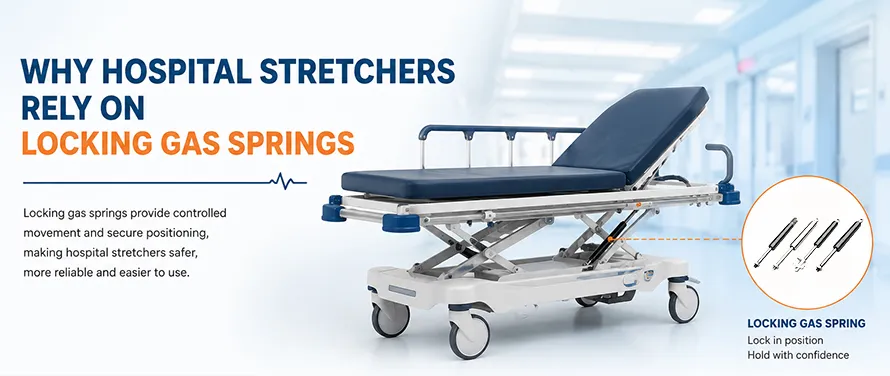
Why Hospital Stretchers Rely on Locking Gas Springs

In emergency departments, intensive care units (ICUs), and trauma centers, a hospital stretcher is far more than a patient transport vehicle—it is a mobile, high-intensity clinical workspace. When a patient’s life hangs in the balance, medical staff rely on fast, seamless, and completely reliable positioning.

For medical mobility equipment manufacturers (OEMs/ODMs), engineering a stretcher that balances effortless maneuverability with absolute stability is a top priority. The core component enabling this balance is the medical-grade locking gas spring (locking gas strut).

This article provides an in-depth analysis of why high-performance locking gas springs are essential for modern hospital stretchers, their key clinical applications, and the technical specifications required to win international medical procurement contracts.

Critical Performance Demands of Hospital Stretchers

Medical stretchers operate in chaotic, high-pressure environments. When clinicians adjust a patient’s position, the motion control hardware must overcome several severe engineering challenges:

  • Sudden Variable Loads: A stretcher must support bariatric patients weighing upwards of 300kg while maintaining the exact same smooth movement and absolute lock reliability as it does for a pediatric patient.
  • Zero-Failure Static Security: During aggressive medical interventions, such as external chest compressions (CPR), the backrest or platform must remain entirely rigid. Even a microscopic slip or flex can compromise patient safety or clinical efficacy.
  • Rapid, One-Handed Adjustment: Medical personnel often have only one hand free to adjust a backrest or Trendelenburg angle while simultaneously managing IV lines or bag-valve-mask ventilation.

Locking gas springs address these demands by storing pneumatic energy to assist the operator, neutralizing heavy patient weight, and offering rock-solid lockability at the press of a lever.

Key Applications of Locking Gas Springs in Hospital Stretchers

In a professional medical stretcher design, locking gas springs are deployed in three distinct, critical areas to facilitate rapid patient positioning:

1. Locking Gas Springs for Fowlers Backrest Adjustment

The Fowler’s position (sitting the patient upright at angles between 30° and 90°) is vital for respiratory distress management, neurological assessments, and patient feeding. By integrating an elastic locking gas spring, the stretcher’s backrest lifts effortlessly, even under the weight of a heavy patient. The inherent compressed gas cushion provides a slight, shock-absorbing dampening effect, ensuring maximum comfort for trauma patients during transport across uneven hospital thresholds.

2. Trendelenburg & Reverse Trendelenburg Tilt Control via Gas Struts

Rapidly tilting a stretcher into the Trendelenburg position (head lower than feet) is a standard emergency protocol for managing hypovolemic shock and promoting venous return. Conversely, the Reverse Trendelenburg position helps alleviate cranial pressure. Utilizing heavy-duty locking gas springs allows clinical teams to perform these radical tilt adjustments smoothly, in seconds, without jerky motions that could dislodge critical medical lines.

3. Heavy-Duty Locking Gas Springs for Bed Height Lift Systems

To prevent occupational back injuries among nursing staff and EMTs, stretchers must transition easily from low loading heights to high examination postures. When hydraulic or mechanical foot-pedal lift systems are assisted by robust locking gas springs, the internal force (F1) offsets the bulk of the patient’s weight. This reduces the physical exertion required by medical staff to elevate the platform, protecting them from long-term strain.

Rigid vs. Elastic Locking: Which Type Fits Stretcher Components?

Understanding the internal locking behavior of a gas cylinder is paramount for medical device compliance and safety. For hospital stretchers, the selection splits sharply between Rigid Locking and Elastic Locking:

Stretcher Gas Spring
Selection Framework

Elastic Locking
Best for Fowlers Backrest

Gas cushion absorbs transport shocks, significantly increasing patient comfort during transit.

Rigid Locking
Best for CPR & Structural Lift

Hydraulic lock design ensures absolutely zero movement under external clinical forces during aggressive interventions.

  • Rigid Locking in Compression (Hydraulic Lock): This is highly recommended for stretchers intended for emergency and ICU environments. When the gas spring is locked, the piston is held by an incompressible column of oil. If a doctor performs high-frequency CPR on the patient, the backrest remains completely immovable, ensuring the chest compressions are fully effective without absorbing energy into a flexing frame.
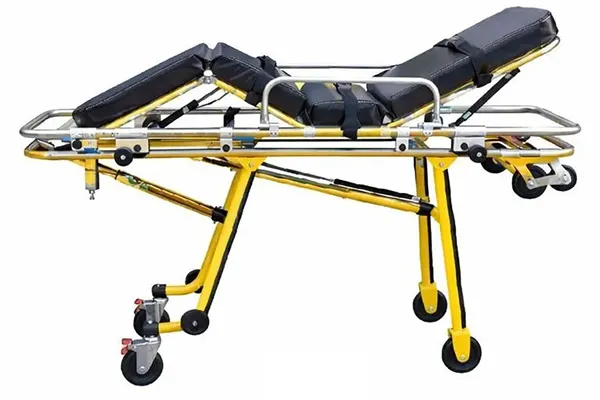
  • Elastic Locking (Pneumatic Lock): This variant locks within the gas chamber. It provides a comfortable, slightly flexible cushion under sudden impacts. It is highly valued in standard transport or ambulance stretchers to mitigate road vibrations.

Typical Specifications for Hospital Stretcher Locking Gas Springs

To guide your R&D engineering teams during the prototyping and product development phases, the table below outlines the standard technical specifications commonly required for medical stretcher applications:

GASTAC Part NumberRod / Tube Dia. (mm)Stroke (mm)Extended Length (mm)Force Range (F1)Locking TypeInstallation Location
HS060240045010/2260 mm240 mm200N - 450NRigidFootrest / Knee Gatch
HS070250045010/2270 mm250 mm200N - 450NRigidFootrest / Knee Gatch
HS080260045010/2280 mm260 mm200N - 450NRigidFootrest / Knee Gatch
HS090270060010/2290 mm270 mm200N - 450NRigidFootrest / Knee Gatch
HS100315060010/28100 mm315 mm300N - 600NElasticStretcher Backrest
HS120355065010/28120 mm355 mm350N - 650NElasticStretcher Backrest
HS130375065010/28130 mm375 mm350N - 650NElasticStretcher Backrest
HS140395070010/28140 mm395 mm400N - 700NElasticStretcher Backrest
HS150420070010/28150 mm420 mm400N - 700NElasticStretcher Backrest
HS180490110014/28180 mm490 mm500N - 1100NRigidTrendelenburg / Tilt
HS200530120014/28200 mm530 mm600N - 1200NRigidTrendelenburg / Tilt
HS220570130014/28220 mm570 mm600N - 1300NRigidTrendelenburg / Tilt

Locking Gas Springs Sourcing Guide

When engineering patient-care mobility platforms, choosing low-quality or off-the-shelf industrial hardware is an unacceptable compromise. Hospital stretchers demand medical-grade precision—components that deliver custom-calibrated force, smooth actuation, and absolute zero-fail locking reliability under maximum load limits.

Because every medical stretcher chassis features unique leverage geometry, mechanical linkages, and center-of-gravity profiles, standard catalog components rarely yield an optimized product. Partnering directly with an experienced medical-grade gas spring engineer ensures your fleet stands up to rigorous hospital workflows.

If you are designing your next-generation hospital stretchers, ICU beds, or emergency trauma equipment, don’t guess the specifications. Contact GASTAC professional team. Our engineers are ready to provide customized gas spring solutions, technical drawings, and OEM bulk quotes tailored specifically to your bed designs.

张航

Stay in the loop

Subscribe to our free newsletter.

Leave A Comment