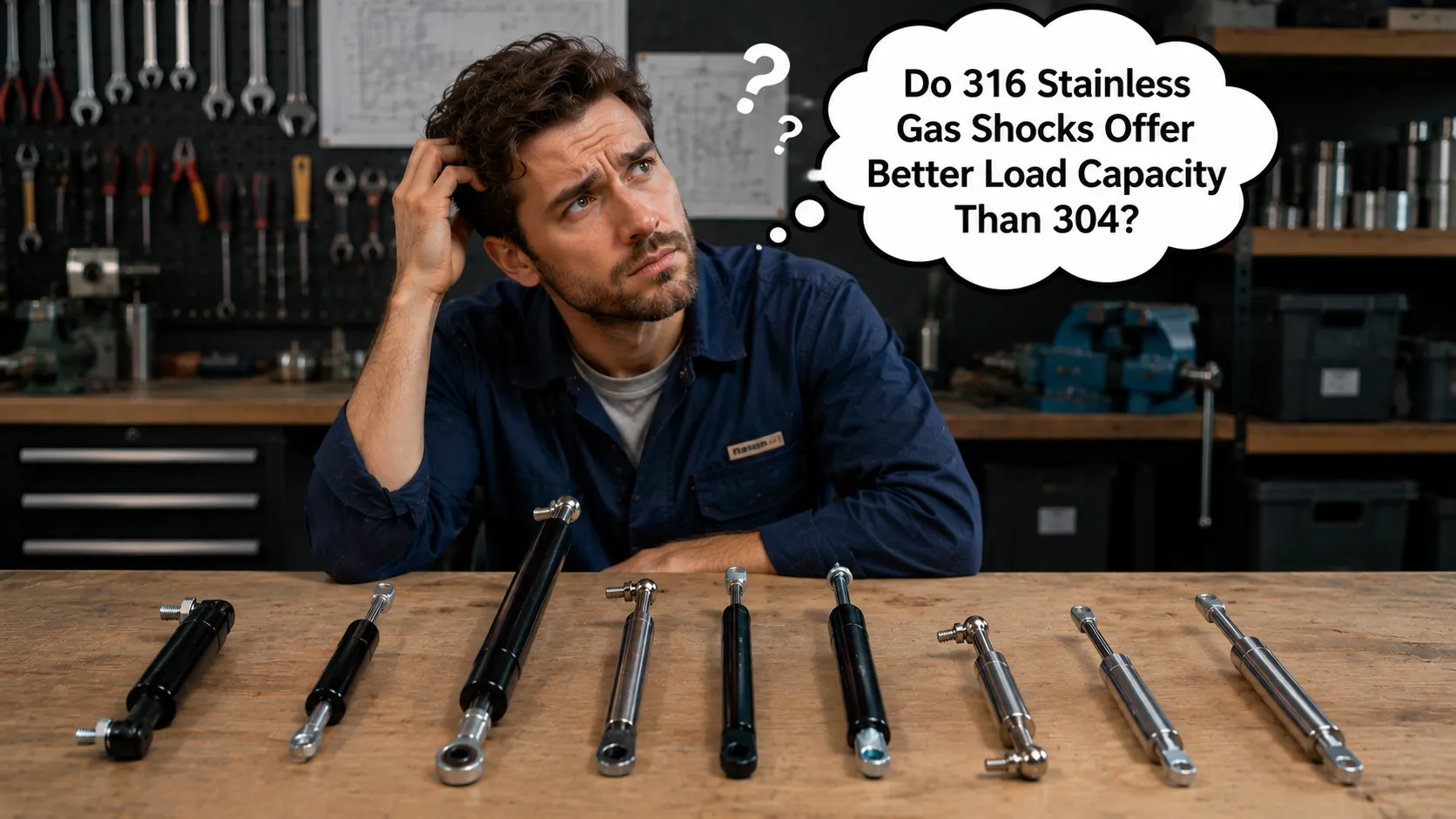




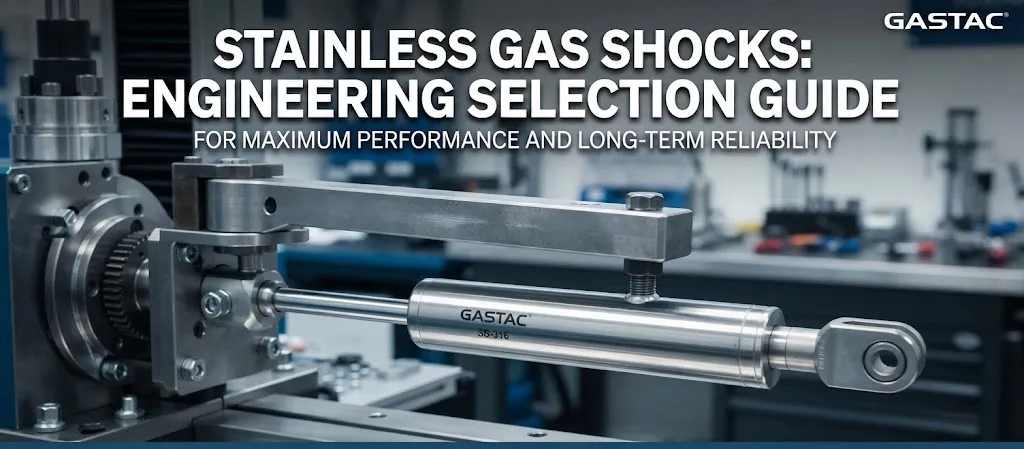


When specifying stainless steel gas shocks for demanding environments, mechanical engineers and procurement teams frequently face a critical question: Does the grade of stainless steel affect the load-carrying capacity of the gas spring?
Specifically, does choosing 316 stainless steel over 304 give you a stronger, higher-capacity shock? To answer this directly: No. A 316 stainless steel gas shock does not inherently have a higher load-carrying capacity than a 304 shock.
Here is the direct, technical explanation of why steel grade does not dictate lift capacity, and what actually determines how much weight a gas spring can support.
Material Strength vs. Internal Pneumatic Force
The misconception stems from confusing material yield strength with internal pneumatic force.
- The Reality: Both 304 and 316 stainless steel possess exceptionally high tensile and yield strengths. Under standard operational pressures, the structural integrity of the cylinder walls for both materials is vastly higher than required.
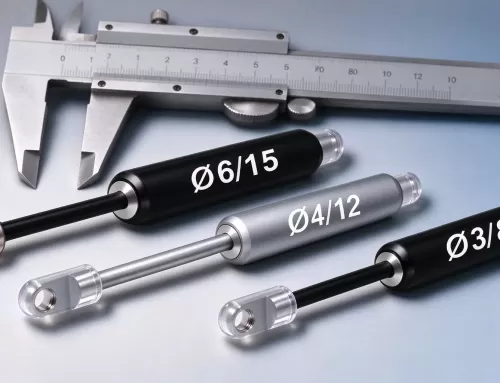
- The Determining Factor: The load-carrying capacity (measured as the extension force, or $F_1$ value) of a gas shock is determined entirely by the internal nitrogen gas pressure, the cross-sectional area of the piston rod, and the internal volume of the cylinder.
If you have a 304 shock and a 316 shock with identical internal charging pressures and dimensions, they will support the exact same load.
304 vs. 316: The True Difference is Longevity, Not Lift
While changing the material from 304 to 316 won’t increase your lifting power, it drastically impacts how long the shock can maintain that lifting power in harsh conditions.
304 Stainless Steel Gas Shocks
- Composition: Contains 18% chromium and 8% nickel.
- Performance: Offers excellent standard corrosion resistance.
- Best For: Industrial machinery, automotive applications, and indoor environments where moisture is present but chemical exposure is minimal.
316 Stainless Steel Gas Shocks
- Composition: Includes 16% chromium, 10% nickel, and 2% molybdenum.
- Performance: The addition of molybdenum provides superior resistance to pitting and chloride-induced corrosion.
- Best For: Marine environments, offshore oil rigs, medical equipment, and chemical processing plants.
How Material Indirectly Protects Load Capacity Over Time
While a 316 shock doesn’t start with more load capacity, it is much better at retaining its capacity over its lifespan in corrosive environments.
If a 304 gas shock is placed in a high-chloride environment (like a marine application), saltwater will cause pitting corrosion on the piston rod. As the rough, corroded rod moves through the rubber seals during operation, it tears the internal seals. This leads to nitrogen gas leakage, causing the shock to rapidly lose its pressure and load-carrying capacity.
By resisting this surface degradation, a 316 stainless steel shock keeps its rod micro-smooth, protects the seals, and maintains its original load capacity over millions of cycles.
Which Stainless Gas Shocks Do You Need?
When selecting your next set of gas springs, separate your requirements into two distinct categories:
For Load-Carrying Capacity: Specify the exact Newton force (F1) required to lift your application weight based on your geometric calculations.
- For Environmental Resistance: Choose 304 for general-purpose corrosion resistance, and upgrade to 316 only if the application demands exposure to saltwater, marine elements, or aggressive chemical washdowns.
To ensure you don’t miss any critical technical requirements during procurement, check out our comprehensive guide on the factors to consider when selecting stainless steel gas shocks
.
If you require high-durability replacement parts for specific vehicle models or standard gas springs for diverse industrial applications, please visit the GASTAC online store. We offer factory-direct pricing, precise 1:1 cross-referencing, and heavy-duty engineering to ensure you find the perfect drop-in solution for your needs.
张航
Stay in the loop