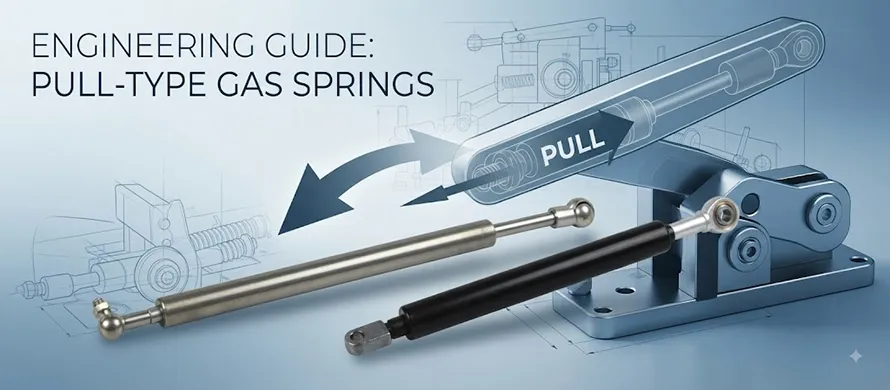
Tension Gas Springs – Reliable Pulling Force for Controlled Motion
Easy To Install & Maintain, Extends Life
Standard fittings and custom end connectors simplify installation, reduce mechanical wear, and ensure long-lasting, stable performance.
Compact & Powerful Pull Force
Controlled pulling power in a compact form ensures smooth, precise motion in tight spaces while maintaining reliability during continuous use.
Smooth & Controlled Retraction
Engineered for smooth, consistent retraction while minimizing noise and vibration, ensuring stable, silent operation and enhanced user comfort.
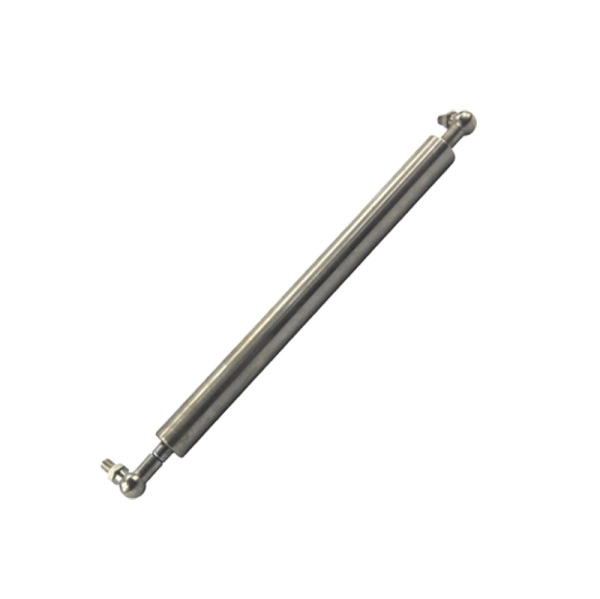
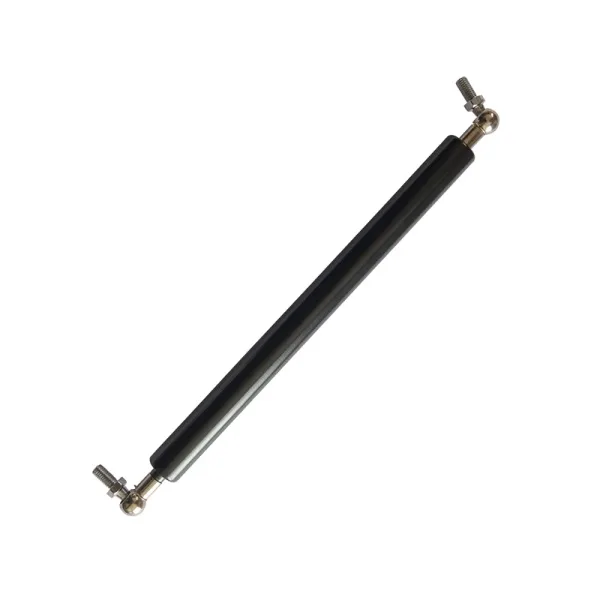
Tension gas springs, also known as pull type gas springs or reverse-acting gas struts, retract the piston rod to produce a controlled pulling force—the opposite of a standard compression gas spring. As a professional gas spring manufacturer since 2007, GASTAC supplies standard and custom solutions for limited spaces and mounting arrangements that require a pulling rather than pushing action. Our tension gas springs are used on bottom-hinged doors and access panels, covers and lids that must be pulled open or closed, and mechanical assemblies or belt drives that require controlled tension.
Tension Gas Springs
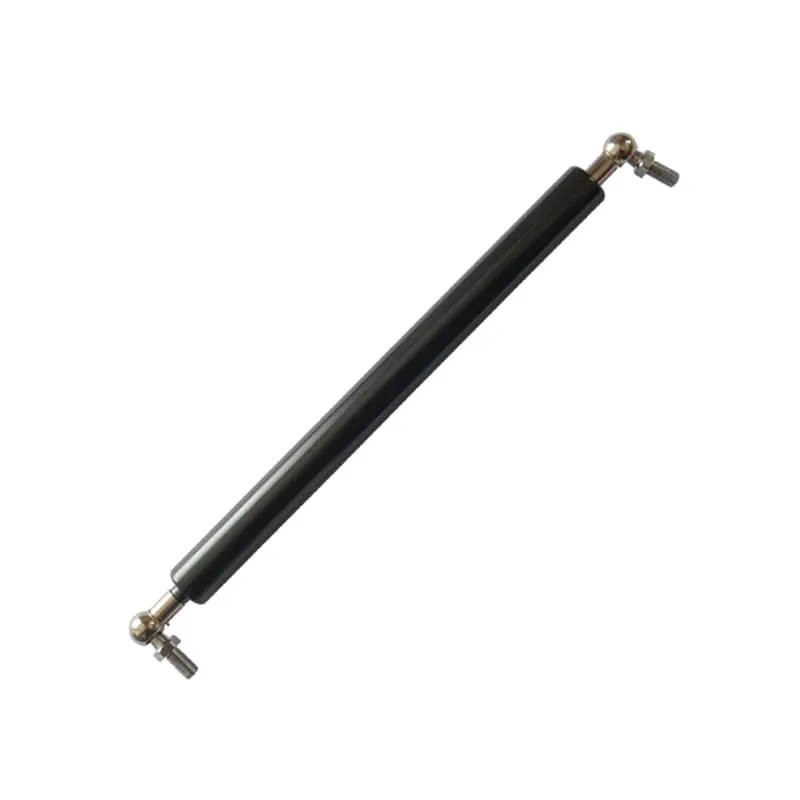
How Tension Gas Springs Work

Tension Gas Springs Specifications
GASTAC tension gas springs are available in rod/body combinations from 6/18 mm up to 14/40 mm, with stroke lengths from 30 mm to 500 mm and pulling forces from 100 N to 3,500 N.
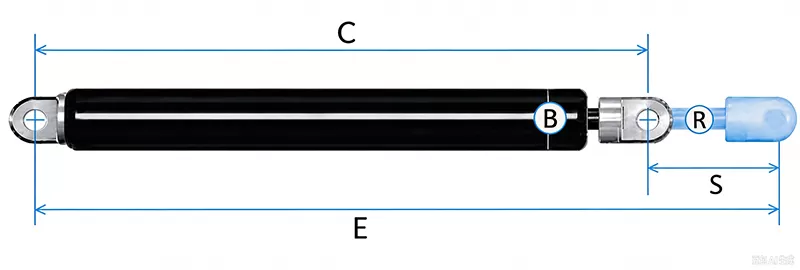
The tables below list our most popular 10-22 and 14-28 series with stroke, extended length, compressed length and force range.
10-22 Tension Gas Springs
| GASTAC Code | Stroke Length (mm) | Extended Length (mm) | Compressed Length (mm) | Rod/Body Diameter (mm) | Force Range F1 (lbs / N) | IGS Cross Reference |
|---|---|---|---|---|---|---|
| GTL102257156 | 57.15 mm (2.25 in) | 155.96 mm (6.14 in) | 98.81 mm (3.89 in) | 10/22 | 25-300 lbs (111-1334 N) | 1CT057154TT |
| GTK102276219 | 76.20 mm (3 in) | 219.46 mm (8.64 in) | 143.26 mm (5.64 in) | 10/22 | 25-300 lbs (111-1334 N) | 1CT076218TT |
| GTK102289270 | 88.90 mm (3.50 in) | 270.26 mm (10.64 in) | 181.36 mm (7.14 in) | 10/22 | 25-300 lbs (111-1334 N) | 1CT089268TT |
| GTK1022140346 | 139.70 mm (5.50 in) | 346.46 mm (13.64 in) | 206.76 mm (8.14 in) | 10/22 | 25-300 lbs (111-1334 N) | 1CT140345TT |
| GTK1022152397 | 152.40 mm (6 in) | 397.26 mm (15.64 in) | 244.86 mm (9.64 in) | 10/22 | 25-300 lbs (111-1334 N) | 1CT153396TT |
| GTK1022203473 | 203.20 mm (8 in) | 473.46 mm (18.64 in) | 270.26 mm (10.64 in) | 10/22 | 25-300 lbs (111-1334 N) | 1CT203472TT |
| GTK1022254569 | 254.00 mm (10 in) | 568.96 mm (22.40 in) | 314.96 mm (12.40 in) | 10/22 | 25-300 lbs (111-1334 N) | 1CT254567TT |
| GTK1022317711 | 317.50 mm (12.50 in) | 711.20 mm (28 in) | 393.70 mm (15.50 in) | 10/22 | 25-300 lbs (111-1334 N) | 1CT318711TT |
14-28 Tension Gas Springs
| GASTAC Code | Stroke Length (mm) | Extended Length (mm) | Compressed Length (mm) | Rod/Body Diameter (mm) | Force Range F1 (lbs / N) | Ameritool Cross Reference |
|---|---|---|---|---|---|---|
| GTL142857207 | 57.15 mm (2.25 in) | 207.01 mm (8.15 in) | 149.86 mm (5.9 in) | 14/28 | 25-350 lbs (111-1557 N) | 1100-2 |
| GTL1428107308 | 107.95 mm (4.25 in) | 308.61 mm (12.15 in) | 200.66 mm (7.9 in) | 14/28 | 25-350 lbs (111-1557 N) | 1100-4 |
| GTL1428158410 | 158.75 mm (6.25 in) | 410.21 mm (16.15 in) | 251.46 mm (9.9 in) | 14/28 | 25-350 lbs (111-1557 N) | 1100-6 |
| GTL1428209511 | 209.55 mm (8.25 in) | 511.81 mm (20.15 in) | 302.26 mm (11.9 in) | 14/28 | 25-350 lbs (111-1557 N) | 1100-8 |
| GTL1428260613 | 260.35 mm (10.25 in) | 613.41 mm (24.15 in) | 353.06 mm (13.9 in) | 14/28 | 25-350 lbs (111-1557 N) | 1100-10 |
| GTL1428311715 | 311.15 mm (12.25 in) | 715.01 mm (28.15 in) | 403.86 mm (15.9 in) | 14/28 | 25-350 lbs (111-1557 N) | 1100-12 |
| GTL1428361816 | 361.95 mm (14.25 in) | 816.61 mm (32.15 in) | 454.66 mm (17.9 in) | 14/28 | 25-350 lbs (111-1557 N) | 1100-14 |
| GTL1428412918 | 412.75 mm (16.25 in) | 918.21 mm (36.15 in) | 505.46 mm (19.9 in) | 14/28 | 25-350 lbs (111-1557 N) | 1100-16 |
| GTL14285141121 | 514.35 mm (20.25 in) | 1121.41 mm (44.15 in) | 607.06 mm (23.9 in) | 14/28 | 25-350 lbs (111-1557 N) | 1100-20 |
| GTL14286151324 | 615.95 mm (24.25 in) | 1324.61 mm (52.15 in) | 708.66 mm (27.9 in) | 14/28 | 25-350 lbs (111-1557 N) | 1100-24 |
Can't Find Your Model?
Tell us your stroke and force — we'll send you a custom engineering drawing within 48 hours.
How to Measure Tension Gas Struts
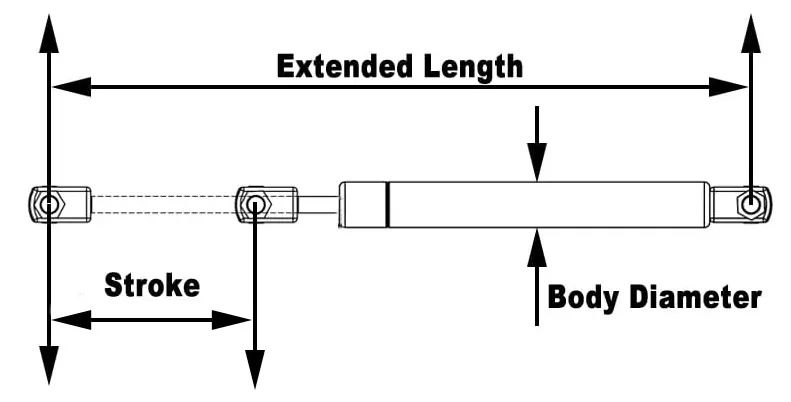
Measure Center-to-Center Length
Do not measure the outer ends. Measure between the mounting center points.
- Compressed Length (Lmin): Distance between the two end-fitting center holes when fully retracted. No fittings? Measure from cylinder end to rod end (thread center).
- Extended Length (Lmax): Fully pull out the rod, then measure between the two center holes.
Calculate the Stroke
Stroke = the maximum distance the rod can be pulled out.
- Formula: Stroke = Extended Length − Compressed Length
- Quick check: With the spring retracted, measure the visible polished rod length.
Measure Rod & Cylinder Diameter
Critical for strength and mounting space. Usually written as “rod / body” (e.g., 8/18 mm).
- Rod Diameter (d): Measure the inner polished rod with a caliper.
- Cylinder Diameter (D): Measure the outer steel body with a caliper.
Confirm the Pulling Force (F1)
The force of a tension gas spring is measured in Newtons (N) or pounds (lbs).
- Check the label: Most tension gas struts have the model and force printed on the cylinder, e.g., “0400N” means a pulling force of 400 Newtons, and “100lb” means 100 pounds.
- Note: Important: If the label is worn and unreadable, since a tension gas spring contains high-pressure gas inside, it is difficult to measure the exact pulling force with simple tools such as a bathroom scale. A professional force gauge is usually required, or the force can be back-calculated from the weight of the door/load it pulls using a torque formula.
Are you measuring a damaged old gas spring, or designing the mounting dimensions for a brand-new DIY project?
Replacing an Old Gas Spring?
Tell us the brand and model printed on the cylinder — we'll look up the original specifications for you.
Send the Model →Selecting for a New Project?
Share the weight of the door, hatch, or equipment you need to pull — we'll help you calculate the required force.
Get a Free Calculation →Custom Tension Gas Springs to Fit Your Application
GASTAC offers custom tension gas springs and pull-type gas struts with selectable materials, dimensions, and force—custom specs available on request.
Tension Gas Springs Advantages
Controlled Pulling Force
Delivers smooth, predictable, linear tension when pulling objects closed or balanced — unlike mechanical extension springs that snap back abruptly.
Constant Force Output
Maintains a stable, uniform force throughout the entire stroke — unlike coil springs, whose force changes sharply as they stretch.
Compact Design
High force capacity in a slim, space-saving tubular form that fits easily into tight enclosures, vehicle interiors, and folding panels.
Smooth and Quiet Operation
Internal gas and hydraulic damping eliminate rattling, jerking, and slamming for quiet, ergonomic movement.
Low Maintenance
All working parts — piston, seals, oil, and nitrogen charge — are sealed inside a steel cylinder. No cleaning or lubrication required.
Design Customization
Available in a wide range of force ratings (10 N to 2,400 N), stroke lengths, and optional locking or stainless steel variants.
Frequently Asked Questions