Trunk Struts
Have you ever tried to load groceries into your car, only to have the trunk lid slowly creep down and bonk you on the head? Or maybe opening your tailgate has become a daily upper-body workout? If that sounds familiar, your vehicle’s trunk struts (also known as lift supports or gas springs) are crying out for a replacement. Enter GASTAC gas spring manufacturer—the premium choice designed to restore that effortless, brand-new car feel to your trunk.
What Are Trunk Struts?
Trunk struts (also known as tailgate struts or lift supports) are mechanical assist devices designed to counterbalance the weight of a vehicle’s trunk lid. They allow the trunk to:
- Open smoothly
- Stay in a fixed open position
- Close in a controlled motion
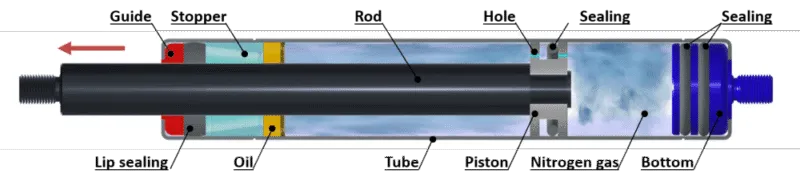
How Do Trunk Struts Work?
Trunk struts operate using a sealed cylinder filled with compressed nitrogen gas. When the trunk is being closed, the gas is compressed inside the cylinder and internal pressure increases, storing energy. When released, the gas expands, pushing the piston rod outward and lifting the trunk smoothly. This gas spring system converts internal gas pressure into an assisting force, eliminating the need for manual effort and ensuring smooth, controlled motion.
The Warning Signs of Failing Trunk Struts
You don’t need to wait until the trunk completely drops to know there is a problem. Keep an eye out for these red flags:
- The Heavy Lift: The trunk feels significantly heavier than it used to.
- The Slow Creep: It opens halfway, stops, or slowly slides back down.
- The Winter Sag: It works fine in summer, but completely fails on cold mornings.
- The Grunt & Squeak: Annoying metallic noises every time you open the tailgate.
GASTAC Trunk Struts Wide Brand Compatibility
The biggest headache with buying car parts? Finding the one that actually fits. GASTAC eliminates the guesswork. We have engineered tailored gas struts to match the exact weight, length, and pressure requirements of the world’s leading automotive brands.
| Segment | Vehicle Coverage | GASTAC Positioning |
|---|---|---|
| 🚗 Everyday Reliability (Japanese & Korean) | Toyota, Honda, Nissan, Hyundai, Kia | The GASTAC Touch: Restores dependable, smooth daily operation with long-lasting performance beyond standard OEM parts. |
| 🚙 Heavy-Duty Strength (American SUVs & Trucks) | Ford, Chevrolet, Jeep, GMC, Ram | The GASTAC Touch: High-pressure gas chamber design enables strong lifting performance even for heavy tailgates in extreme conditions. |
| 🏎️ Premium Precision (European Luxury) | BMW, Mercedes-Benz, Audi, Volkswagen, Volvo | The GASTAC Touch: Engineered damping control ensures smooth, silent, and refined motion without bounce or instability. |
How to Choose the Right Trunk Struts & Get Ready?
This is where most DIY projects fail—not during the installation, but because of the wrong selection. To ensure a 100% successful upgrade, follow this quick prep checklist:
Part 1: Verify Your Vehicle & Technical Specs
To avoid a trunk that either crashes down or pops up aggressively, make sure you double-check these key details (or simply choose GASTAC’s 1:1 OE-spec matched struts to skip the guesswork):
- Year, Make, and Model: Manufacturers change specs frequently. A 2017 RAV4 might use a completely different strut than a 2018 RAV4. Always verify your exact year.
- Force Rating (N): The lifting force (measured in Newtons). Too low, and the trunk sags; too high, and it slams open violently.
- Extended & Stroke Length: The total open length and the actual working travel distance of the inner rod must match your original parts.
- Mount Type: Ensure the end fitting gas spring(ball socket, clip-in, or OEM-specific end fitting) matches your car’s original design.
Part 2: Prepare Your Workspace (Before You Start)
Once you have the correct GASTAC struts in hand, do these 3 simple things before touching any tools:
- The Pair Rule: Always replace trunk struts in pairs. If one has failed, the other is already worn out and carrying double the load.
- The Tool: Grab a small flathead screwdriver. This is the only tool you will need.
- The Helper (Critical): Grab a sturdy prop rod (like a broom handle) or ask a friend to hold the trunk lid. Once the old strut is removed, the lid becomes incredibly heavy and can drop instantly.
How to Replace Trunk Struts (10-Minute DIY)?
You don’t need a mechanic or a hefty garage bill to fix this. Replacing your trunk struts is a simple DIY project that requires only a flathead screwdriver.
- Step 1-Secure the Trunk Lid: Place your prop rod securely, or have your friend hold the trunk completely open. Never skip this step—the lid will drop the moment the first strut is released.
- Step 2-Pry the Metal Clip: Locate the small metal band/clip wrapping around the ball joint of the old gas strut. Slide your flathead screwdriver under the clip and pry it slightly outward to unlock the tension.
- Step 3-Pop Off the Old Trunk Strut: While holding the clip open with your screwdriver, pull the gas strut away from the car’s ball stud. It will pop right off. Repeat this for both the top and bottom connectors.
- Step 4-Snap on the GASTAC Trunk Strut: Take your new GASTAC gas strut (the clips are pre-installed). Line up the socket with the car’s ball stud and press firmly until you hear a satisfying “Click.”
What Separates Premium Gas Struts from Cheap Generics?
When shopping for automotive gas springs, it’s easy to think they are all the same pieces of metal. However, the real difference lies entirely hidden inside the pressurized cylinder. Here is a technical look at what you are actually paying for when you choose a premium brand like GASTAC over low-cost generic parts:
| Technical Feature | Cheap Generic Struts | Premium Engineering (GASTAC) | Why It Matters to You |
|---|---|---|---|
| Sealing System | Single-lip rubber seal (prone to hardening & cracking) | Multi-lip synthetic rubber sealing system | Prevents gas/oil leakage, especially on freezing winter mornings (-40°C) |
| Opening Motion | No speed control (snaps open violently, shaking the car frame) | Built-in hydraulic end-dampening | Safely slows down the last few inches of travel for a smooth, luxury-car lift |
| Piston Coating | Basic painted or chrome-plated steel (prone to rust & pitting) | QPQ nitrided surface treatment (mirror-smooth) | Resists rust from road salt and moisture, protecting internal seals from wear |
| Lifespan Testing | Minimal or no batch testing (fails within 6–12 months) | Rigorous 100,000+ continuous cycle testing | Ensures long-term safe trunk operation, not short-term failure |

Contact Us
Interested in our products, pricing, MOQ, or customized solutions? Fill out the form below to submit your inquiry or request a quote, and our team will get back to you within 24 hours.